| |
|
|
| |
Nymphing continued.
Tue 12th June, 2012
|
|
|
|
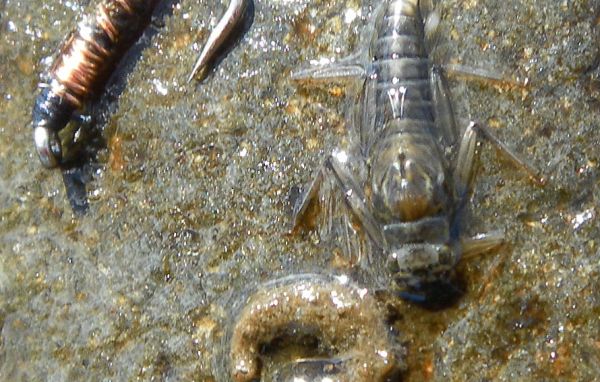
This week we'll return to the subject I started a couple of weeks ago before I got side-tracked by those lovely fat silver rainbows that ran the river ... learning from our mistakes. I've noticed that whether your a beginner or a first time visitor to the Tongariro when we start fishing this river most of us tend to make the same bad calls. Looking back I was in the same boat as everyone else and didn't have a clue ! Last time we looked at " concrete feet syndrome " which is a fairly common one and will not only cost you fish but the good will of other anglers. Unless of course your a devotee of the Bridge Pool which as well as being one of the most consistent stretches during the spawning runs also has its own, very special set of rules. This week another classic cock up ... fly size. 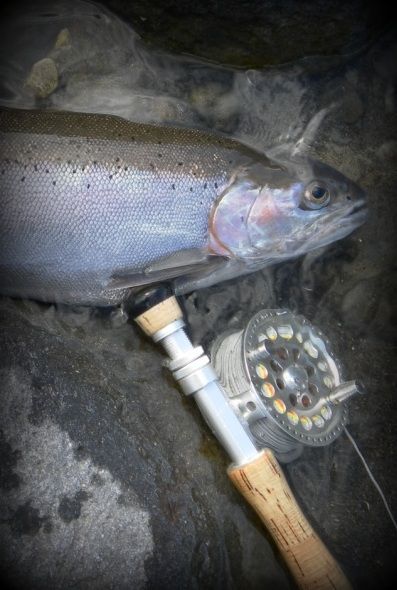
After they deported me from the South Wales valleys and I eventually caught my very first glimpse of the Tongariro, my immediate impression was ... big river,
full of big fish, big is best, so big flies ... BIG MISTAKE ! At the time, it seemed logical to me that in a large river like this the trout would not only be able to spot a big fly more easily but would find a big meal more attractive.
I can't remember the exact setup that I was using but it would probably have consisted of a couple of size 10 unweighted gold head Hare and Copper or Pheasant Tail nymphs. Not too much wrong with the pattern choice but at that time I also hadn't realized the importance of using weight for success on this river.
My unleaded offerings were tied using pretty light gold beads and unless I was drifting them through shallow water its a fair bet they were nowhere near the bottom. Even if they had got down to some feeding trout a lot of the time those big nymphs would have aroused a little bit of suspicion, unless the Tongariro had suddenly been invaded by mayfly the size of sparrows ! Ok that's a bit of an exaggeration but you can see what I'm getting at. I'm not inferring either, that trout won't ever take big nymphs, on occasions of course they will. During the spawning runs for instance, you may find that you catch more fish than usual on the bomb.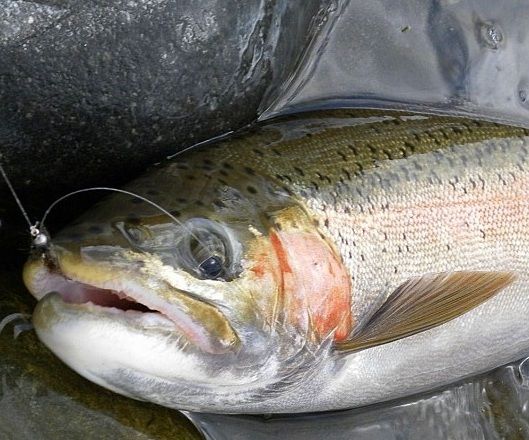
This is because there are thousands of trout making the annual dash from the lake and for many it will be their first time back in the river since they were juveniles. These fish are still a bit " green " and wouldn't know a caddis from a coconut, so if it looks remotely like food its quickly snaffled before their mates get a chance. The consensus is that unlike salmon, steel heads continue to feed until they get near the redds. Once there, far stronger urges take over and any thought of food is temporarily put on the back burner. But as usual the poor ole males get pretty stoked up during all this and will have a go at anything that comes near their bit of river. This is born out by data gathered from research surveys that show that most jacks are caught defending spawning sites, where as the hens tend to get caught while on the move before they get anywhere near the redds. When spawning is over the very tired, sorry looking specimens that are left know that to survive they must eat and quickly regain their lost condition. Once again food becomes their number one priority and in the early stages of their return journey will hit just about everything you put near or over them. Not all of these kelts head straight back to Lake Taupo, some remain in the system for months and continue to feed on the large numbers of caddis, mayfly and other insects that thrive in and along the river. These recovering rainbow slabs are the mainstay of our late spring and summer sport on the Tongariro. A percentage never return and become resident trout sharing the Tongariro in the warmer months with their much bigger, wilier cousins. But as the weeks go by their almost reckless feeding behavior slowly begins to change. 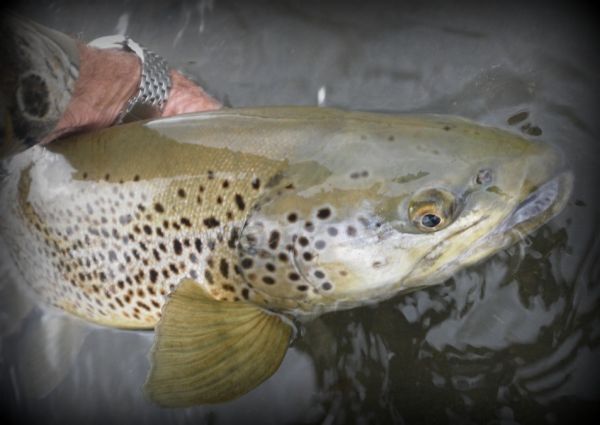
These are now a very different kettle of fish to the unsuspecting trout that first left the lake. By now both species know what the river has to offer and how it should behave as it drifts downstream towards them.
We're a little way off summer yet but as the temperatures begin to increase so will the insect activity right through the water column.
With less rainfall the river will gradually drop back to its summer level bringing with it the low clear conditions that make things more challenging.
This is the time for the angler to also change tactics, lighter rods, thinner tippets, may be digging out the dry fly box or trying different nymphing setups. But its a funny thing ... if needs must, most of us ... at least those who can still see, wouldn't think twice about using a tiny dry fly. But how many would be as keen to fish a similar size nymph along the bottom.
The most popular rig when anglers are fishing "small naturals" will probably consist of a bomb with some sort of size 14 nymph tied to the dropper.
Have another look at the lead photograph. I spent ten minutes or so looking under the rocks in the riffles above a pool and on the day this was by far one of the larger mayfly nymphs I came across. 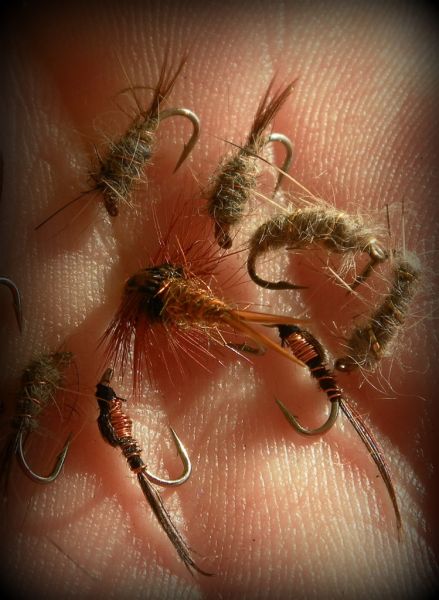
Right! I hear you say but its bigger than the P.T nymph next to it. Yes it is, except that's a size 18 and the bulk of the nymphs and larvae I found were smaller than that.
We know that trout are opportunist feeders, for them it really all comes down to numbers. If there is an abundance of a particular insect { or a particular stage in that insects life cycle } they are only too happy to eat it. If enough of these new prey items float by for long enough, trout will often ignore everything else and focus only on this new food source. The obvious example is the cicada. Every year we get an emergence of this big insect all along the river.
For several weeks the " singing " males can be heard high in the trees as they try to attract a mate. This activity peaks in February and can be the catalyst for some fantastic top water action but the cicada fishing isn't good every year. Trout can't climb trees so again it comes down to numbers and the hatches have to be large enough to ensure that a steady supply of cicadas end up in the river.
I fish a cicada as an indicator all year round but its only during those few weeks that I expect to get takes on the big dry because the trout have to be conditioned to taking them.
The same thing happens in any waterway when there is a sustained and plentiful food source. And like other places for trout in the Tongariro this often means caddis or mayfly, especially the larvae or nymphs.
The majority of these are very small indeed so we're back to the numbers game. The fish will encounter an almost inexhaustible supply of these very small insects on a daily basis and have no qualms about feeding on them. So the next time that guy downriver is getting a few and you ain't, why not think 16's and 18's... and remember ... sometimes size does matter but big isn't always best.
This weeks fishy quote sums it all up :
" The best fisherman I know try not to make the same mistakes over and over again; instead they strive to make new and interesting mistakes and to remember what they learned from them. "
John Gierach ~ " Fly Fishing the High Country "
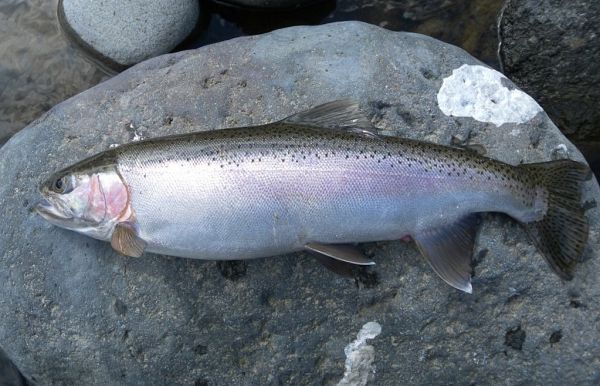
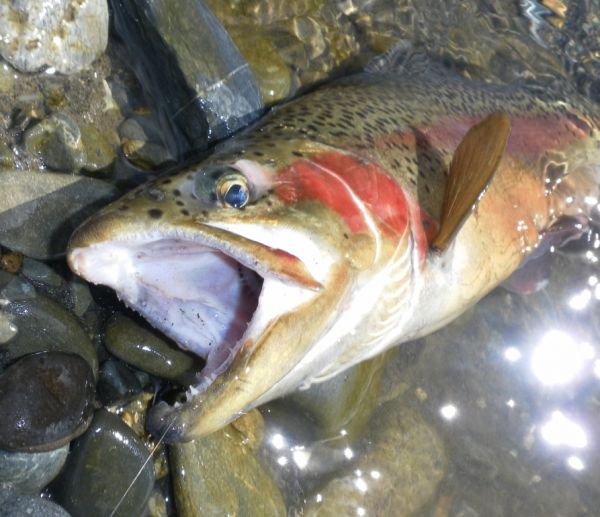
I've spent most of the week on the Tongariro and had some terrific sport. With a little color in the river until Wednesday conditions were spot on and nymphers and wet-liners both caught. The unsettled weather prevented significant day time hatches but I did notice fish rising as a few may fly came off between the squally showers. For me the town pools were a bit disappointing but the middle and upper reaches more than made up for them, so that's where I spent most of my time.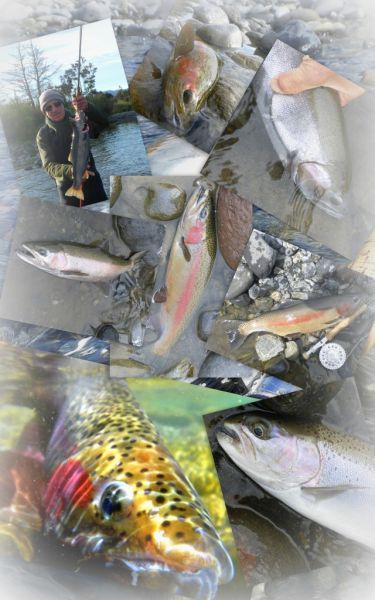
With some of the other venues now open angling pressure has been non existent and on a couple of occasions once I got upriver it seemed as if I had the Tongariro all to myself. In fact the only other angler I came across on my travels was Ray from Taupo who was staying nearby in his camper van. That's him on the right holding breakfast.
With so few anglers around I was often first through the places I fished and had some great action. But things didn't always go to plan because some of the better fish were literally unstoppable.
Towards the end of the week although I caught plenty of jacks displaying their best courting colors amongst them were some quite silver males. A sudden increase in numbers of male trout can sometimes be an indication that a run of ladies is on the way, something to watch out for over the coming days.
Its been raining since early this morning and as I write this the river is rising, currently at 80 cumecs. This will keep the fish coming and providing it doesn't flood too badly ensure more good fishing again next week.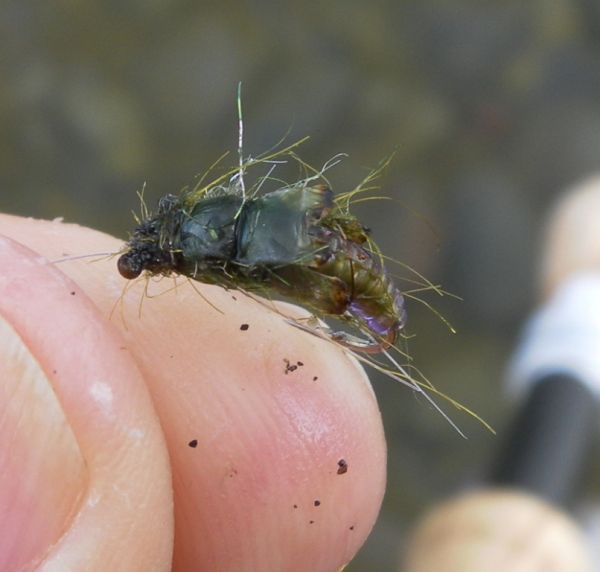 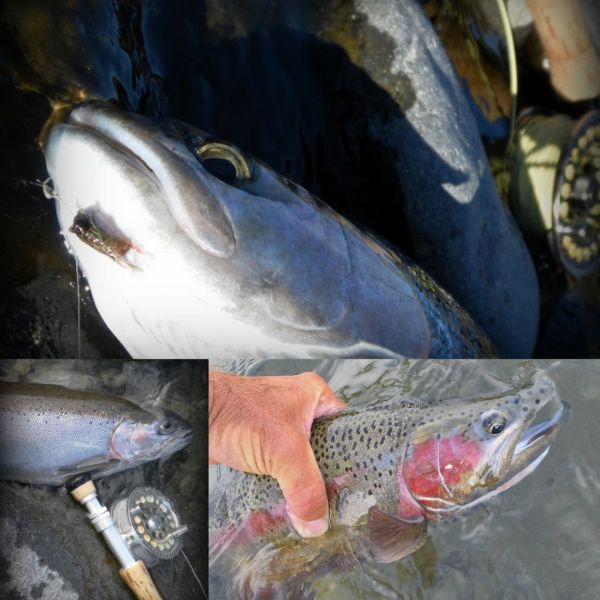
Two flies that really stood out were the ever reliable Hare and Copper and a weighted Caddis emerger type thing that I first tied last year.
Caddis prefer the oxygenated water between pools but many anglers walk straight past this faster stuff because its often fairly shallow. These riffles are also favorite places for trout and providing you rethink your approach you should do ok.
The fish on the left all took the emerging pupa in fast runs.
The H & C is one of the oldest and simplest fly fishing nymphs and a proven fish catcher. Its a great searching pattern when your not sure what the fish are feeding on and a very popular choice on the Tongariro.
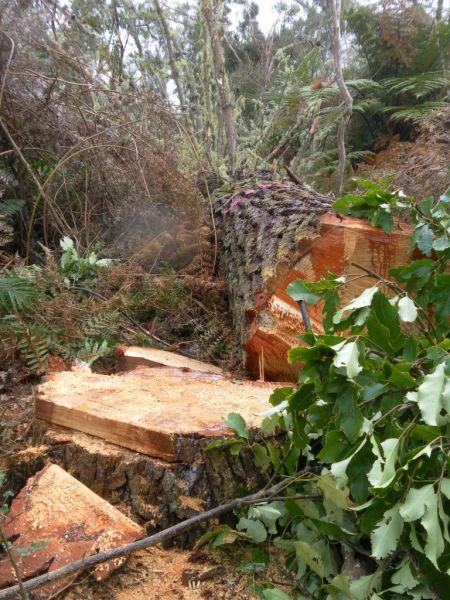
Those of you that walk the T.R.B above Red Hut bridge may have noticed the smell of fresh pine in the air. On my way back to the truck on Thursday afternoon I could here the buzzing of chainsaws in the distance. A little further along the track I was stopped by a forestry worker look-out warning people that they were felling trees nearby and as we chatted another pine crashed to the ground. According to info on the Advocates for the Tongariro web-site :
" The project to eliminate pines started several years ago, with poisoning in the Department of Conservation reserves on the left bank of the Tongariro River upstream of the Trout Centre and later, by the AFTR, on the right bank. The work, unfinished, has moved upstream to about 1 km above the Red Hut suspension bridge. The effect of the poisoning there is not subtle, there are many trees in the brown stage, in which the needles die and drop. Soon the skeletons will turn grey and later they will rot away ".
There must have been a change of plan because originally I don't think their intention was to cut them down. So if your up that way don't forget your hard hat.
Last report we looked at fishing with smaller size flies and lighter tippets but its not much good scaling everything down { especially fishing the dry } if its connected to the leader/tippet with a great big barrel of a knot. So I'm going to let you in on a secret. Its a knot that was shown to me over thirty year ago while fishing in Ireland near Disert which lies in the foot hills of the Blue Stack Mountains. Brendan Walsh was an old mate who occasionally guided fly fishermen visiting this area so rich in Celtic history. His claim to fame was that after a careless moment while unhooking a large pike he was the only one handed gillie in County Donegal! Ever since he was a small boy he'd formed a fascination with the mechanics of knots and was regarded as a bit of an expert. Some of the trout in his patch were notoriously finnicky and would closely examine the dry before they sucked it in. So after countless fishy refusals he came up with the smallest knot ever invented ... which he called the " Secret Knot "
Of course the whole story is a complete pack of lies and is just a yarn that I made up to have a bit of fun with people I take fishing ... the truth is he wasn't Irish he was Scottish ... honest! 
HOW TO TIE THE SECRET KNOT. { One of the smallest fly fishing knots }
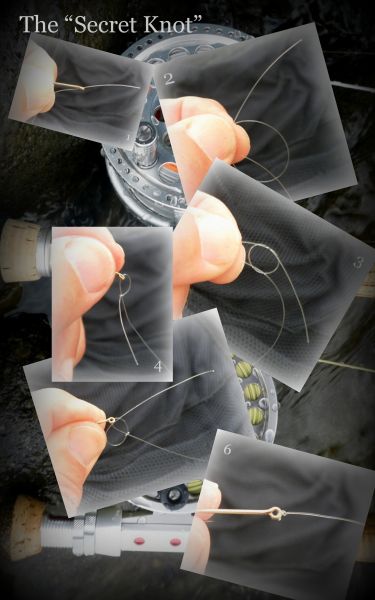
The " Secrets " out and its one of the easiest to tie. To demonstrate I've used an oversize hook and 10 lb bs line.
Step One:
Start by threading the line through the eye from the underside of the fly.
Step Two:
Take the tag end behind the main line then return it to the front and form an overhand knot.
Step Three:
Pull the tag end to partially tighten the knot.
Step Four:
Slip it down towards the eye.
Step Five:
Push the tag end through the still open loop.
Step Six:
Moisten the line with saliva. Then holding the fly in one hand and the main line in the other grip the tag with your third hand ... which non-fisho's call teeth and pull line and tag to fully tighten the knot. If it has formed properly the tag should stick out at 90 degrees, trim the end.
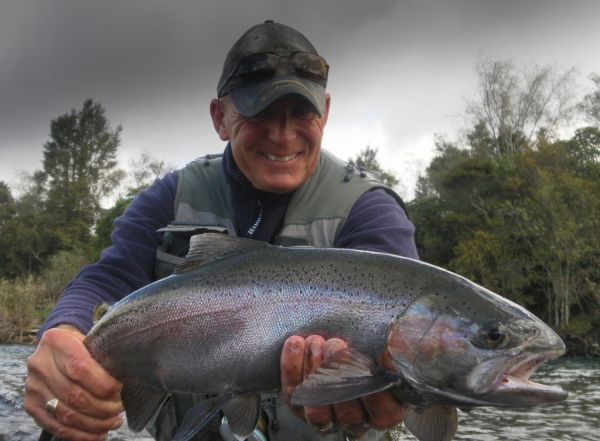
Even though I've used the knot for years and have complete faith in it. Its simplicity does cause others some concerns particularly if they're using fluorocarbon. I use it mainly for small dry flies but when I decided earlier this week to share it with you I thought I'd better thoroughly field test it on your behalf, which also gave me a plausible excuse to be out and about every day. As the river continued to clear I fished with fluoro and small nymphs, mostly size 16. Nearly every one was attached using this knot. I've played fish in all kinds of water including the heavy stuff in the tail-outs of pools. Although I haven't successfully landed every hookup none were lost because the knot failed. And some of the fish, including the one below were pretty determined to get away.
This weeks fishy quote:
" Put backing on your line; even if you never use it. It helps you dream." ~ Jimmy D Moore
UPDATE:
5.30 a.m Sunday 14th October
The Tongariro peaked at 250 cumecs plus but is already back to fishable levels. Wet-liners should score well as the color drops out with plenty of fish around for everyone during the week ahead.
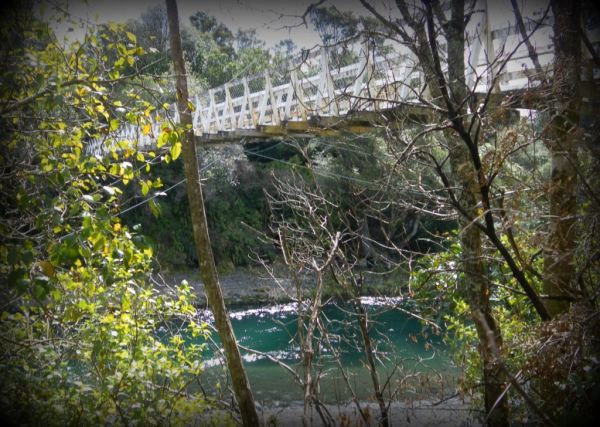
I don't think many would argue that so far this year there has been a marked improvement in both the quality and quantity of fish caught in the Tongariro. Last Sunday I stood on the swing bridge above Red Hut with some holiday-makers and watched a steady trickle of migrating fish slowly file past in the pool below. The last few years had seen a gradual decline in the numbers of fish using the upper stretches during the spawning runs. But this time around they seem to have been more evenly distributed throughout the river. It's a bit too early to tell and I'm no scientist but could the destruction of previously good spawning area's from the lower Bridge Pool down be affecting their behavior already? The loss of places like the Braids is definitely having an effect on anglers habits.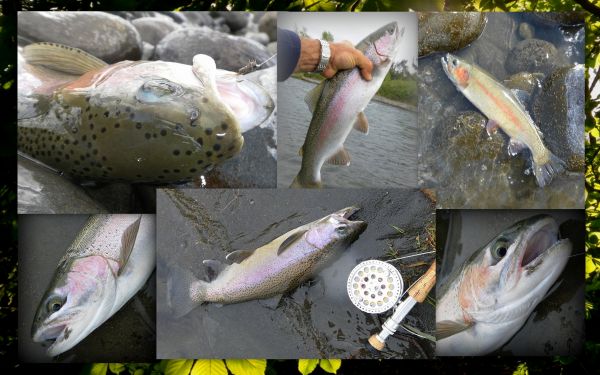 Whether we like it or not its forcing us to look elsewhere. Perhaps its a similar story for the fish. Stretches of a river don't become popular by accident. Easy access plays a part but anglers tend to use them because they consistently produce good results. It'll take a few years to get an accurate overview but fairly recent ariel surveys showed that there were far more anglers regularly fishing from the town pools down than above. However if the numbers of trout using the middle and upper river continues to build then so will the numbers of fishermen chasing them. I've often commented this year on the absence of any angling pressure while fishing between the Stag and Blue Pool. These middle/upper river pools used to be very popular until the fish using them declined a few years ago. But I have a feeling this may alter in future because this year has seen them start to fish well again and there's always been something special about having a successful day on this lovely part of the Tongariro. Whether we like it or not its forcing us to look elsewhere. Perhaps its a similar story for the fish. Stretches of a river don't become popular by accident. Easy access plays a part but anglers tend to use them because they consistently produce good results. It'll take a few years to get an accurate overview but fairly recent ariel surveys showed that there were far more anglers regularly fishing from the town pools down than above. However if the numbers of trout using the middle and upper river continues to build then so will the numbers of fishermen chasing them. I've often commented this year on the absence of any angling pressure while fishing between the Stag and Blue Pool. These middle/upper river pools used to be very popular until the fish using them declined a few years ago. But I have a feeling this may alter in future because this year has seen them start to fish well again and there's always been something special about having a successful day on this lovely part of the Tongariro. 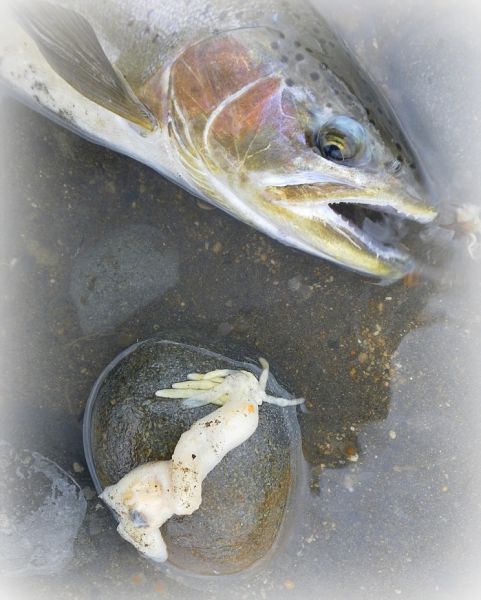 This sounds like the start of a really bad joke but a funny thing happened earlier in the week. I'd returned to the bach to change my waders after they'd sprung a leak while fishing a very cold Stag Pool. Gail was over in Turoa doing her " Eddie the Eagle " impersonation before the ski fields closed for the summer. So with a couple of hours to kill before the eagle landed This sounds like the start of a really bad joke but a funny thing happened earlier in the week. I'd returned to the bach to change my waders after they'd sprung a leak while fishing a very cold Stag Pool. Gail was over in Turoa doing her " Eddie the Eagle " impersonation before the ski fields closed for the summer. So with a couple of hours to kill before the eagle landed
I walked across the road to the Braids. There are still one or two interesting little spots over there and as I unhooked this greedy jack it coughed up its breakfast ... may fly nymphs ... caddis ... fish eggs and half a calamari squid !! I can only assume it was tossed into the water by " accident ", unless some enterprising angler has discovered a new trout " fly " ... so much for small naturals. Squid aside, there have been some pretty good hatches of caddis and mayfly along the river depending when you fished.
I happened to be in Judges during a particularly good mid-morning hatch and the fish spotted them almost as quickly as the swallows and fan-tails. As more and more duns started floating downstream a few trout began rising.
At the time I was fishing a couple of mayfly emerger patterns through the top of the pool and one fish frightened the life out of me when it went for the indicator dry. As so often happens when you get an unexpected take on a dry fly I did a first class job of completely missing the fish. But a couple of casts later the dry disappeared and
I wasn't surprised to find myself playing a very lively kelt that had taken the suspended nymph.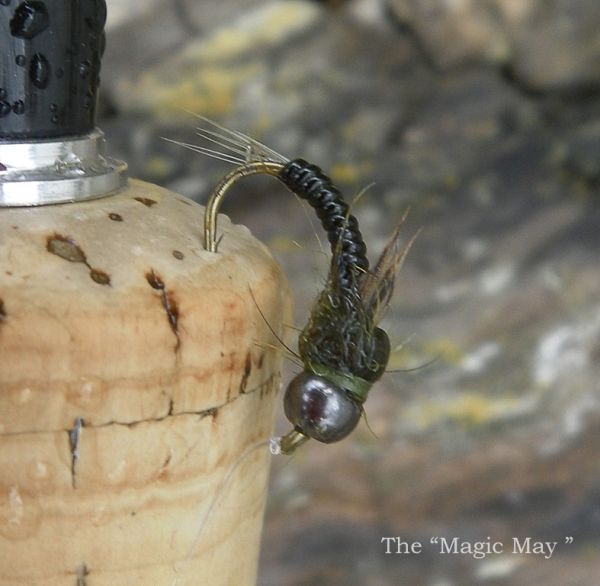 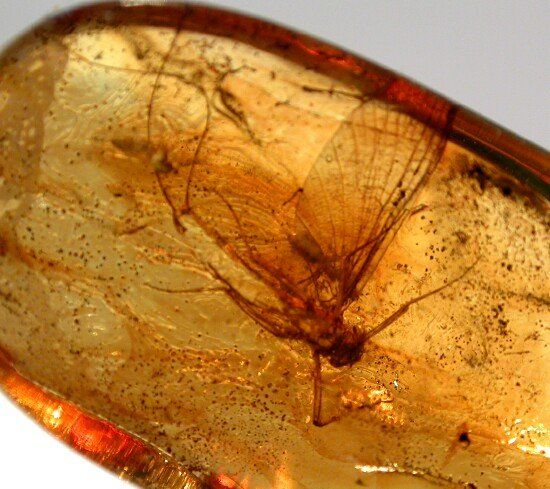
Mayfly have been around for millions of years and their ancestors pre-date the dinosaurs. The oldest full body fossil was found in 2008 when fossil hunters discovered the 300 million year old ancient impression while exploring woods at the back of a suburban shopping complex in Massachusetts. The leader of the geology study group who made the find said at the time " That it was like winning the lottery because the bodies of flying insects are usually not preserved due to their softer, fragile nature. Scientists more often find only the remains of wings, which are not digested easily by predators." The mayfly pictured right entombed in Baltic amber is a "youngster" by comparison at a mere 40 million years old. This example was found in the Kaliningrad district of Russia. Mayfly have some unique characteristics which set them apart from other insects. For instance both males and females have paired genitalia. Yep! the male has two penises ...yeah ... twenty years ago I'd have thought the same thing too. Nowadays I have enough trouble coping with the problems one gives me never mind two !! To help the male tolerate this terrible handicap the female has two gonopores which I believe is a posh name for a hole or opening. No wonder they have such a short adult life-span they must be worn out. Of more interest to the fly fisherman is the sub adult stage of their life cycle which anglers call " duns " May fly are the only insects to go through another instar after they have acquired usable wings. These sexually immature adults are often compared to tiny sail-boats as they're carried downstream and a good hatch can trigger some great surface action. 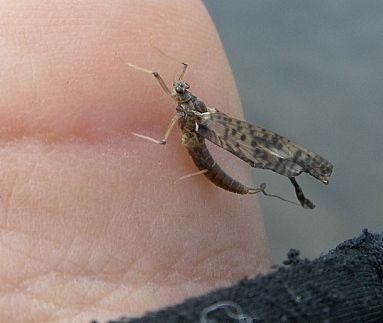
I scooped this one off the water during a hatch above Judges and its likely it had only just shed its nymphal shuck because its wings still look a bit like a deflated balloon. The duns are slightly smaller but thicker set than than the final adult fly. The wings are opaque and the whole insect lacks the bright, sleek look of the mayfly spinner. Anglers are sometimes unsure whether trout are feeding on the emerger or the dun. The secret is to observe how they're actually taking the insect. If the head of the fish shows its a fair bet they're feeding on mayfly duns. Where as a dorsal fin, then tail rise that creates a bulge or splash would suggest they're feeding on emergers as they attempt to reach the surface. The fly pictured above is called
" Sean's Magic May " and is one to try beneath a dry to simulate the ascending nymph.
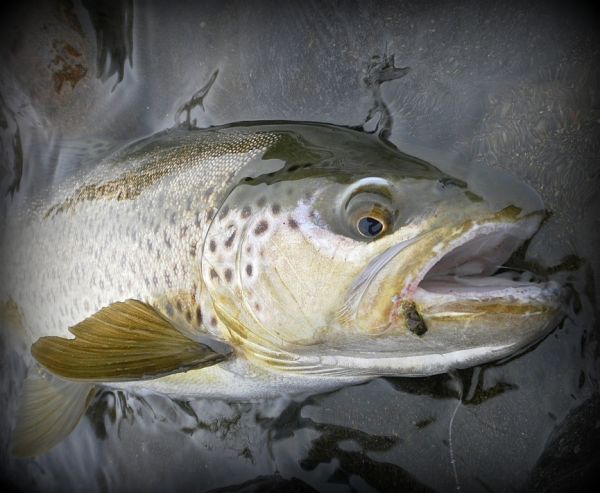 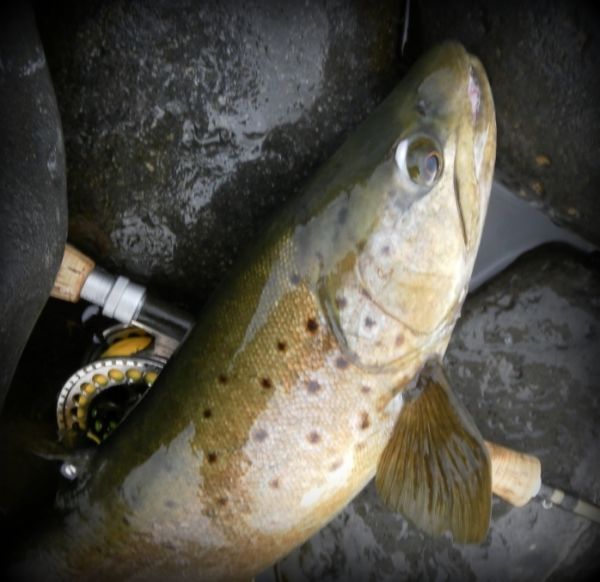
Typical weather for the time of year with all four seasons putting in an appearance. At the moment it looks as if we may have some rain next week which should encourage more fish to run. I've had a couple more browns since the last report, not huge fish but I love catching them anyway. They seem to have a year long presence in the river now and appear most weeks in someones fishing report. They're just another good reason too come and enjoy the Tongariro ... not that you need one. It's happy holiday time for Gail and I so I'm not sure if I'll have time to post another report before we go. In the meantime ponder this weeks wise words :
" They say you forget your troubles on a trout stream, but that's not quite it. What happens is that you begin to see where your troubles fit into the grand scheme of things, and suddenly they're just not such a big deal anymore."
~ John Gierach
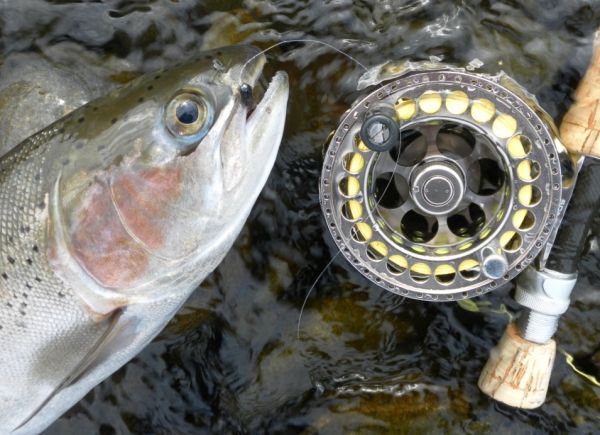
One of the questions you always get asked by anglers who have just started fly fishing is ”how often do you change the fly“? Too be honest there is no easy answer to this one because it depends on so many things. Like other aspects of fly fishing it’s a decision that’s based on experience which has evolved into a sort of sixth sense. Until you give it some thought you don't know how you know ... you just do. I don’t think any angler turns up at the rivers edge, glances at his watch and says to himself …”I’ll change the fly in ten minutes time“ … it just doesn’t work that way. Most of us have our favorite “go to flies“ in our box. These are patterns that have consistently caught fish in the past and if your nymphing the Tongariro odds are it will be something that represents a caddis or mayfly.
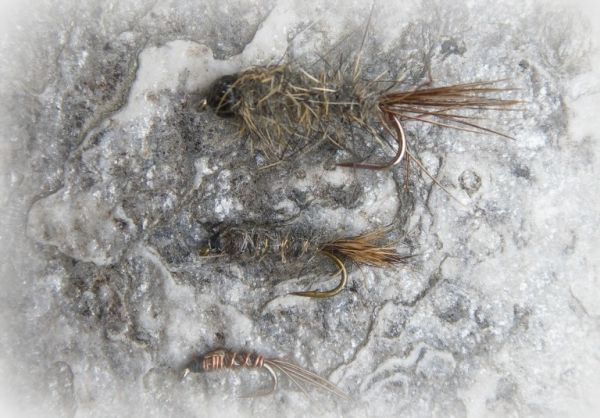 When I'm fishing naturals under the indicator I usually start with a searching rig consisting of a buggy tied bomb with a couple of flies below it. These are nearly always combinations of a hare and copper, pheasant tail or caddis larvae in size 14 to 16 like the set up on the left … nothing special … no secret flies … just well known patterns that will do a perfectly good job of mimicking the aquatic insects that trout expect to find near the river bed. The hare and copper is one of the oldest and still one of the most effective nymphs out there. If you’re not sure what to use this is the fly to try first. Its simplicity allows the fish to think its whatever they want it to be and there’s a lot of truth in the old saying that “most of what a trout eats is brown, fuzzy and about a half inch long” . When I'm fishing naturals under the indicator I usually start with a searching rig consisting of a buggy tied bomb with a couple of flies below it. These are nearly always combinations of a hare and copper, pheasant tail or caddis larvae in size 14 to 16 like the set up on the left … nothing special … no secret flies … just well known patterns that will do a perfectly good job of mimicking the aquatic insects that trout expect to find near the river bed. The hare and copper is one of the oldest and still one of the most effective nymphs out there. If you’re not sure what to use this is the fly to try first. Its simplicity allows the fish to think its whatever they want it to be and there’s a lot of truth in the old saying that “most of what a trout eats is brown, fuzzy and about a half inch long” .
Where ever you're fishing first of all try and guesstimate the depth and set the indicator accordingly. As a rough guide most anglers use the one and a half times the estimated depth formula. So if you think its six feet deep set the indicator around 10 ft from your flies. Look at the speed the current is flowing, this not only determines leader length and breaking strain but also how much weight to use to get your flies down to trout feeding near the bottom.
Pick out the likely fish holding area’s which we’ve covered before in “reading the water” and as you move through the pool or run fish them thoroughly. In the warmer months keep an eye open for any insect activity around you which could indicate the trout may be feeding on something at or just below the surface, if so you may need to switch to another method. 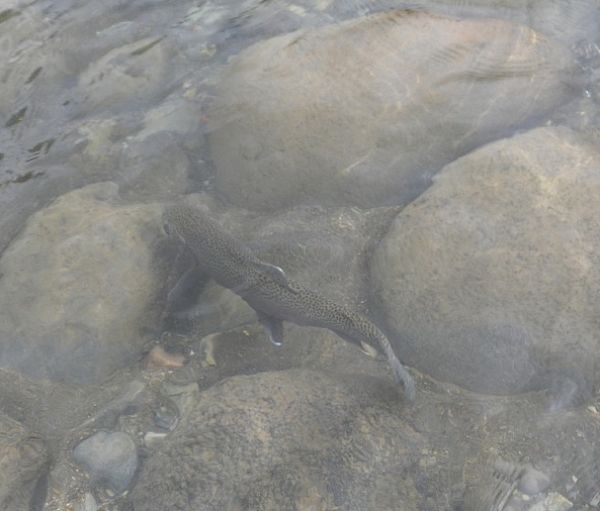
Pay extra attention in faster runs or riffles because if you're a new fly fisher it can sometimes be difficult to spot surface feeding trout in this kind of water and you may miss this cue to change tactics. How’s the water clarity? During low gin clear conditions it may be worth using a lighter breaking strain tippet and leader or try increasing the distance between the bomb and your nymphs. Still no takers ... may be you need to work on your presentation, for instance your mending may not be quite right making the flies look a bit suspect as they drift downstream. There’s no point tying on a different set if they're going to behave in the same unnatural way as the last lot. In other words heaps of other stuff to think about before you put all the blame onto the poor ole fly. 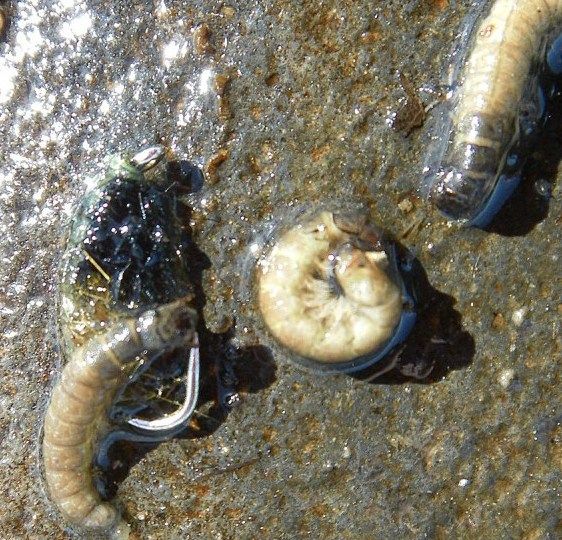 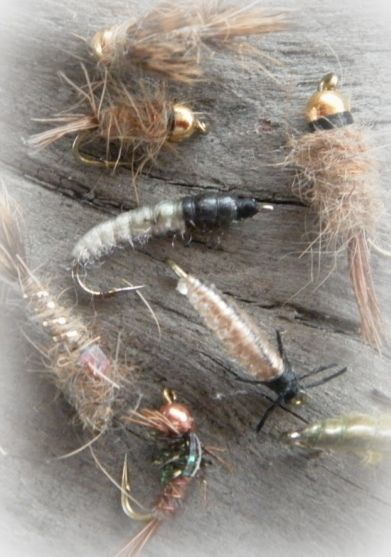
This all sounds a bit complicated but it becomes second nature as your experience grows. OK … you’ve gone through this check-list and still nothing … now what? This is the time to start thinking about a change of fly. Put the rod down, take a break and spend the time turning over a few rocks in the water above where you’re fishing. Compare what you see underneath with what you’ve been using. Usually you'll find a variety of nymphs and larvae in all sizes but I bet many of them will be a size or two smaller than your artificials, so first of all try a smaller fly. Sometimes the predominant species on the underside will be caddis larvae. If you’ve been fishing with nymphs switch to a caddis pattern that matches those you’ve found. And if they're free swimming larvae pick one tied with plenty of body segmentation, personally I find they work better. Something else to bear in mind is that even when the water looks crystal clear there are always all kinds of non-edible bits and pieces being carried downstream. Trout love cool, oxygenated water, e.g., the head of a pool where the river tumbles in from the run above. But you can imagine how it must look below the surface, bits of vegetation, tiny stones and twigs, bubbles etc all mixed up together, yet despite this trout still manage to spot food. In conditions like this why not give them a helping hand and try flies that have a little more “presence”. Patterns tied with flash, colored beads or rubber legs work well here or indeed anywhere that you need your fly to stand out.
So now you've ticked off the remainder of the list and still the indicator hasn't gone under. I think it might be time to make a move and find some easier fish because there are either none in front of you or they're just not feeding. When you're nymphing there are no hard and fast rules on how often you should change your flies because {unlike dry fly fishing} most of the time you can’t actually see the trout refuse them. I suppose it becomes an educated guess at whats happening below the surface. If possible, before I give up on on a place, I like to make at least two passes along the stretch I’m fishing. If nothing happens by the time I get halfway through the second pass then I’ll try a different fly. Some days you get a gut feeling that its worth persevering and you may do this multiple times, other days you just know its not happening and you'll move on fairly quickly.
So ... in answer to the question "how often do you change the fly"?... Well ...it all depends ...
This weeks fishy quote offers another point of view :
" Something to think about : If you fish the wrong fly long and hard enough, it will sooner or later become the right fly." ~ John Gierach
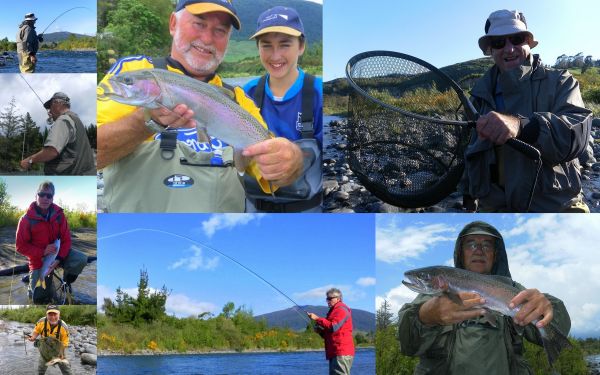
The year ended with some pretty steady fishing over the Christmas period and it really didn't matter much where you fished. Even though most of them were kelts, many of the trout I saw caught spent as much time out of the water as they did in it, resulting in some spectacular action and lots of happy anglers.
Sitting on my perch in the bar of the Bridge Motel you meet a lot of fly fishermen because its fast becoming a favorite watering hole for river fisho's and boat anglers staying in Turangi. All of the boaties I talked to were wrapped with both the numbers and quality of the fish they'd taken from lake Taupo. If the photos they showed me are any thing to go by I don't blame them because some of the trout were stunners. With more growing time to go before they enter the rivers later in the year you can't help but feel positive about 2013 and the upward trend in the fishing that was noticeable last year seems set to continue.
A mixture of warm sunshine and showers forecast for the next week or so. Some good browns have already been caught and you could encounter one at any time, anywhere along the river. But from now on its worth targeting them and with "cicada time" just around the corner it may be worth putting your hiking boots on and heading downriver. Compared to the noise of the cicadas flying around my garden things are still a bit quiet along the banks of the Tongariro but as soon as the weather settles down numbers should increase and the males will start their tymbals vibrating as they attempt to attract a mate. I missed last years cicada hatch so I'm looking forward to the coming weeks, lets hope its a good year for them ... see you out there.
Tight lines guys
Mike |
|
|
| Back to Top |
|
|
|
|
|
|
|


