| |
|
|
| |
Twenty great Summer tips.
Fri 11th November, 2011
|
|
|
|
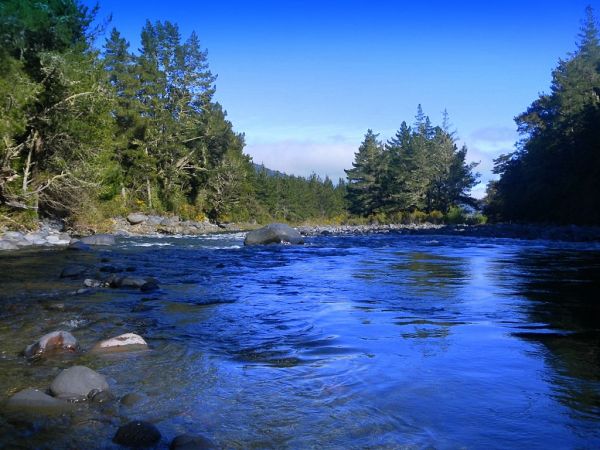
We've had all four seasons on the Tongariro this week and I suspect the mayfly are wondering whats happening. Sunday morning dawned to a still clear day and I was on the river early.
But within an hour or so the skies darkened and the temperature plummeted as a front moved through.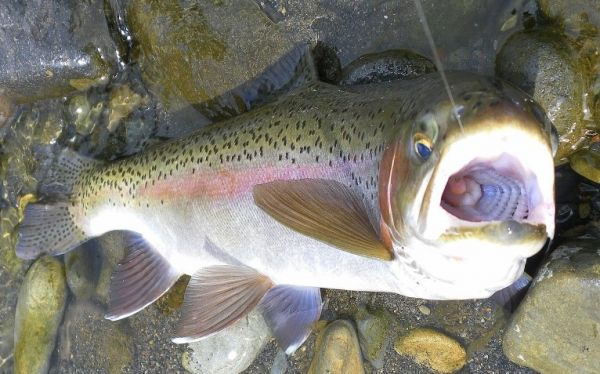 The icy wind put a stop to any surface activity so I went back to the indicator and landed some very hungry trout. First on globugs and later small nymphs. Look how far back that globug is, even the P.T nymph is well inside this eager beavers mouth. There are still fresh run fish moving through and they will keep coming for a little while yet. But I think you will notice a slow down in the momentum of the annual spawning migration. Don't let this put you off, there are plenty of fish in the river and the recovering kelts that will be the mainstay of our sport over the summer are everywhere. The icy wind put a stop to any surface activity so I went back to the indicator and landed some very hungry trout. First on globugs and later small nymphs. Look how far back that globug is, even the P.T nymph is well inside this eager beavers mouth. There are still fresh run fish moving through and they will keep coming for a little while yet. But I think you will notice a slow down in the momentum of the annual spawning migration. Don't let this put you off, there are plenty of fish in the river and the recovering kelts that will be the mainstay of our sport over the summer are everywhere.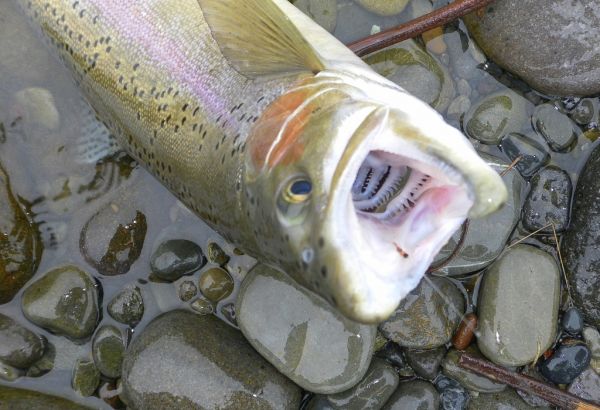
These next few months are my favourite time on the Tongariro. Angling pressure tends to be lighter and and as things warm up the heavy winter waders can be put away in favour of quick dry shorts and hiking boots. There's nothing quite like standing in a cool river on a sticky hot summers day casting to rising fish. On Monday it was all change again and while I was walking the tracks of the upper river there wasn't a breath of wind and by the time I reached the Sand Pool there were small clouds of mayfly drifting back and for above the surface of a gin clear river.
Even though it had turned out to be a beautiful late Spring morning I never saw another soul the whole time I was there. Looking around as you walk the banks of this stunning river it makes you realise how lucky we are to have such a fantastic piece of "Gods own" right on our doorsteps. No wonder people from all over love coming here.
At the end of last weeks report Paul had left Iceland bound for British Columbia. His round the world adventure continues after he touches down in Canada. {edited}
"I arrived in Vancouver and caught a bus to a small town called Chilliwack. The journey takes around two hours which is pretty good, plus you get to see a bit of the country side along the way. Once there I hired guide Curtis Meyers of B.C fly fishing charters, he has a web-site www.bcflyfishingcharters.com. The Fraser river is basically unfishable unless you have access via boat and Curtis has a jet boat so I booked him for a couple of days. In October the target species for the Fraser river are Pink salmon, Chum salmon, Coho salmon and Chinook salmon. The latter are the largest of the Pacific salmon and in some parts of the world grow up to one hundred pounds. However here on the Fraser river the big ones are forty to sixty pounds but the average would be between eighteen and thirty pounds. First day on the Fraser I hooked a pretty massive Chinook and it busted me off.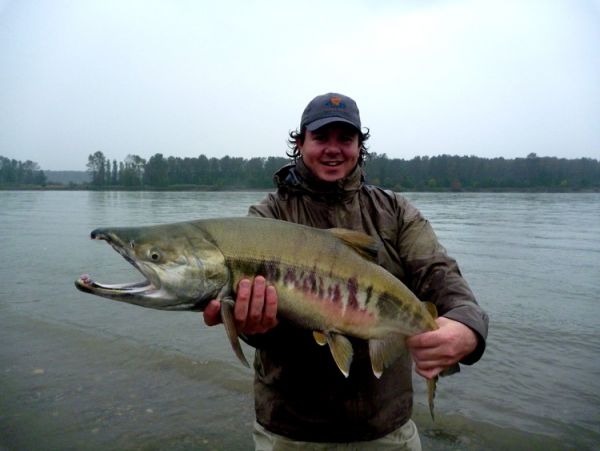 Later I hooked and landed a few Pinks and a few Chum salmon, mainly Pinks though. Most of the Pink salmon had already spawned and were starting to die. It wasn't uncommon to hook forty or fifty of these a day! All you would feel was weight on the end of the rod and initially you weren't sure if you had hooked a living fish or a dead one. However when you did connect with a fresh fish you knew about it because the line would get ripped from your hands and your finger would either be cut or burned or both. Which is a great feeling when stripping flies 10 hours a day, luckily I always carry a carton of band-aids with me. I managed to catch a few Pink salmon that were reasonably fresh from the ocean and still had a bit of life in them but I was pretty keen to try and get a Chinook, so the next day we went looking for them. We fished one likely looking spot for several hours without even a strike. Curtis and I were contemplating a move to a new location but decided to give it another half hour. Suddenly over a hundred meters away we saw the bow waves of a few fish coming up the river. Now you have to try and time it so your fly is swinging by at the right time. I managed this bit ok because a fish nailed the fly and took off down stream. First the fly-line then fifty meters of backing were towed off the reel, then everything went slack as the 20lb tippet busted. They can have sharp teeth and sometimes the line gets caught on them. Anyways Curtis tied on another fly, a big red marabou streamer with lots of gold tinsel and it wasn't long and I was onto another Chinook. The fish took the fly and started jumping and rolling, then raced off downriver and I had to follow. I was about 80 meters down before it was finally landed and boy was I relieved to finally get a Chinook, from memory it weighed around eighteen pounds. Later I hooked and landed a few Pinks and a few Chum salmon, mainly Pinks though. Most of the Pink salmon had already spawned and were starting to die. It wasn't uncommon to hook forty or fifty of these a day! All you would feel was weight on the end of the rod and initially you weren't sure if you had hooked a living fish or a dead one. However when you did connect with a fresh fish you knew about it because the line would get ripped from your hands and your finger would either be cut or burned or both. Which is a great feeling when stripping flies 10 hours a day, luckily I always carry a carton of band-aids with me. I managed to catch a few Pink salmon that were reasonably fresh from the ocean and still had a bit of life in them but I was pretty keen to try and get a Chinook, so the next day we went looking for them. We fished one likely looking spot for several hours without even a strike. Curtis and I were contemplating a move to a new location but decided to give it another half hour. Suddenly over a hundred meters away we saw the bow waves of a few fish coming up the river. Now you have to try and time it so your fly is swinging by at the right time. I managed this bit ok because a fish nailed the fly and took off down stream. First the fly-line then fifty meters of backing were towed off the reel, then everything went slack as the 20lb tippet busted. They can have sharp teeth and sometimes the line gets caught on them. Anyways Curtis tied on another fly, a big red marabou streamer with lots of gold tinsel and it wasn't long and I was onto another Chinook. The fish took the fly and started jumping and rolling, then raced off downriver and I had to follow. I was about 80 meters down before it was finally landed and boy was I relieved to finally get a Chinook, from memory it weighed around eighteen pounds.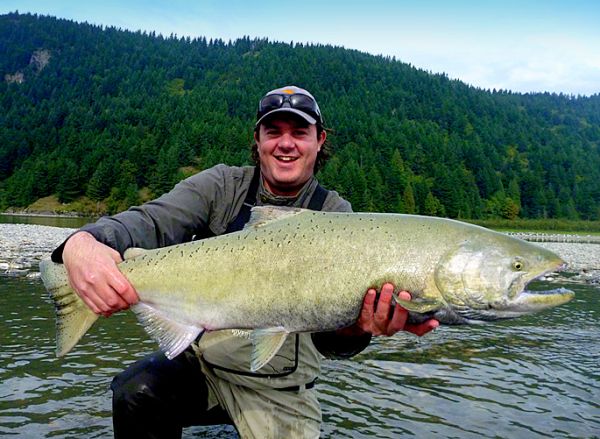 The fish was released and the pressure was off so I started to relax a bit more. I'm still not sure why I felt like I had to catch a Chinook but it was a great feeling and I started bombing these long double hauls out in the the main flow. The fish was released and the pressure was off so I started to relax a bit more. I'm still not sure why I felt like I had to catch a Chinook but it was a great feeling and I started bombing these long double hauls out in the the main flow.
Not that I had to cast that far out because the fish were cruising up the river only about 40-50ft out from the edge and I was already standing 10ft out. But I was getting some major swing time though, then just as it swung into that 45ft range... bang... another Chinook.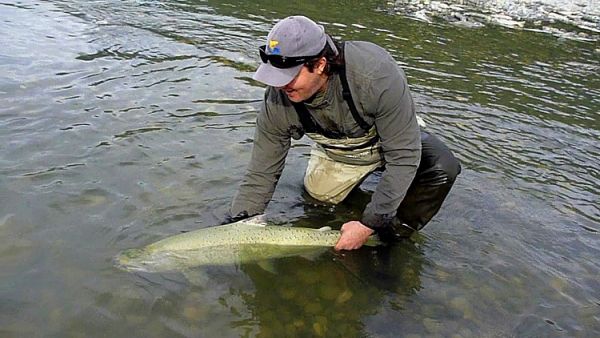
This one was a lot bigger and took me into the backing instantly. I ran down the edge of the river to try and keep up with him desperately trying to get line back. I was about 100 meters from where
I started and had got back a bit of line but he was still going down stream. Off he went off again... taking more line and I had to follow. Before I knew it I ended up 250 meters from where I started. Curtis had the net ready and after several attempts he finally went in... woohoo !! A 30lb Chinook salmon on the fly... I was pretty happy and booked a days Sturgeon fishing for later in the trip.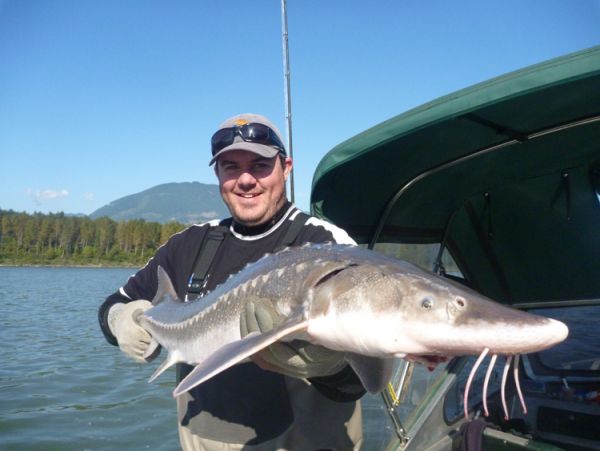
Although I never did see any bears in Canada,
I did almost soil myself at the site of a tree stump which bore a magnificent resemblance to one. Later that day I almost did the same thing again when I couldn't get my waders off fast enough but I did see a bear print which was cool. I also fished the Vedder river while in Canada only because there were a few Coho going up. Most of them were hatchery fish which had the adipose fin cut off so you could tell the wild salmon from the reared fish.
The Vedder has easy access but its a very annoying and frustrating place to try and fish. Angler pressure is high and its hard to find room to slot in. There are guys there that deliberately snag them by running big hooks with a weight and a sinker up the line. They cast out and let it bounce along the bottom hoping it snags into a salmon. As soon as they feel something on the line they strike, often striking several times during one cast. Its pretty ordinary and illegal, most people that fish on that river kill all the fish they catch as well. I'm not opposed to keeping fish, I keep them sometimes... but seriously you don't need 20 Coho salmon that weigh six to ten pounds each. This killing of fish just for the sake of it does cause problems. While I was there over thirty vehicles all registered from one particular country had all four tires slashed... that's one hundred and twenty tires all up.
After two weeks in Canada I was starting to get a bit sick of the crowded rivers and the constant threat of being eaten by bears. That's when I remembered a TV show I had once watched about a place where the rivers are wild and so are the Coho... but then again there's always a country... somewhere... so I jumped on a plane and headed for Alaska"... too be continued next week.
This is the time I actively start searching out the big browns. I know its early but as I mentioned last week I landed the first one in December last year. It would have been unlikely that I was fortunate to be on the spot and catch the very first brown to swim up the Tongariro. 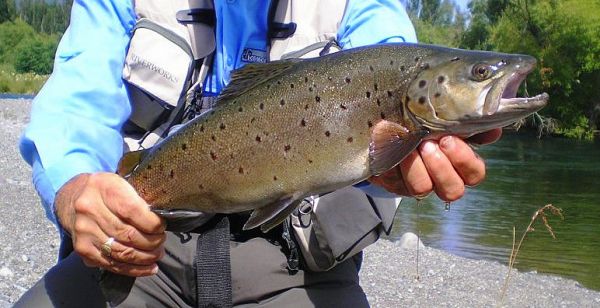 So its a pretty safe bet others were already ahead of it, which is why I'm beginning to make regular visits to places that over the years have consistently produced these awesome fish. I had some very good information a week ago that they were on the move and this has been confirmed by recent reports. If you fancy targeting them yourself there are a few simple things you can do to load the odds in your favour. It really all boils down to changing your approach and slowing things down a little. Where possible stay out of the water, at least at first. If your nymphing or using the dry approach any likely stretch slowly and quietly from downstream. Stop for a minute or two and carefully polaroid the water in front and ahead of you. At first light, the tail of a pool is a good place to start and you will be surprised how close to the bank they will be. So its a pretty safe bet others were already ahead of it, which is why I'm beginning to make regular visits to places that over the years have consistently produced these awesome fish. I had some very good information a week ago that they were on the move and this has been confirmed by recent reports. If you fancy targeting them yourself there are a few simple things you can do to load the odds in your favour. It really all boils down to changing your approach and slowing things down a little. Where possible stay out of the water, at least at first. If your nymphing or using the dry approach any likely stretch slowly and quietly from downstream. Stop for a minute or two and carefully polaroid the water in front and ahead of you. At first light, the tail of a pool is a good place to start and you will be surprised how close to the bank they will be. 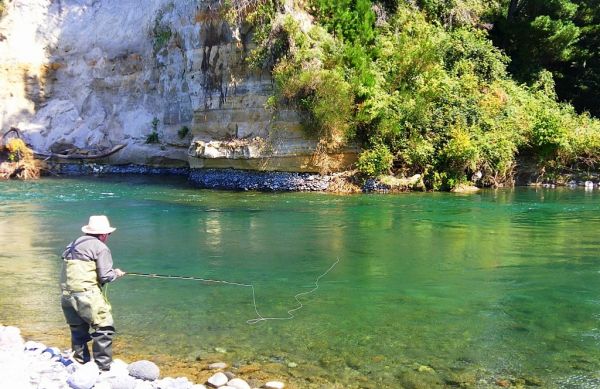 When the sun gets up, if I'm in a pool I tend to concentrate my efforts near the inside of feed lanes at the head. In runs or glides the shade and shelter of any undercuts or overhanging foliage will be a attractive to them. You'll often spook them literally right under your feet as they lie motionless underneath the bank. Like most anglers if they are anywhere near old tree roots or other snags I tend not to bother. Even if you did fool one, you would have to be using a surf-caster to get it out of there. They are lazy feeders and unless its well worth it prefer not to chase prey items around. You will rarely will find them holding in fast water for long periods. So the shallower, slower water on the inside seam at the head of a pool is a banker spot. Here they have plenty of time to inspect any food items that are brought down and if danger threatens they can easily slide away into the deeper water nearby. When I'm chasing browns even if I haven't actually spotted a fish ahead of me, when ever I'm fishing somewhere that I'm expecting to find them, I still approach with caution. I always assume one could be at home and stay well back and behind any possible fish. I prefer to put longer casts up, starting quite close in then altering the angle each successive cast, a bit like a fan, exploring all the water in front of me. Only when I'm absolutely sure I've covered it all will I take a few steps up and begin the whole process again. Once you get used to recognising the most likely holding water your chances will increase. The adrenalin rush you get when you hook your first large brown is indescribable. No two fish react the same way when hooked. But when they steam off using those big pectoral fins to power through the water your heart will be thumping away and your hands shaking as the line and backing disappears through the rod rings. If you do manage to land it {and sometimes its a big if} you'll be left with memories of an angling experience that its unlikely you will ever forget. So don't be too bothered that the runs are beginning to slow. With less angling pressure and Summer just around the corner this is a special time to be on the Tongariro and I'm really looking forward to it. When the sun gets up, if I'm in a pool I tend to concentrate my efforts near the inside of feed lanes at the head. In runs or glides the shade and shelter of any undercuts or overhanging foliage will be a attractive to them. You'll often spook them literally right under your feet as they lie motionless underneath the bank. Like most anglers if they are anywhere near old tree roots or other snags I tend not to bother. Even if you did fool one, you would have to be using a surf-caster to get it out of there. They are lazy feeders and unless its well worth it prefer not to chase prey items around. You will rarely will find them holding in fast water for long periods. So the shallower, slower water on the inside seam at the head of a pool is a banker spot. Here they have plenty of time to inspect any food items that are brought down and if danger threatens they can easily slide away into the deeper water nearby. When I'm chasing browns even if I haven't actually spotted a fish ahead of me, when ever I'm fishing somewhere that I'm expecting to find them, I still approach with caution. I always assume one could be at home and stay well back and behind any possible fish. I prefer to put longer casts up, starting quite close in then altering the angle each successive cast, a bit like a fan, exploring all the water in front of me. Only when I'm absolutely sure I've covered it all will I take a few steps up and begin the whole process again. Once you get used to recognising the most likely holding water your chances will increase. The adrenalin rush you get when you hook your first large brown is indescribable. No two fish react the same way when hooked. But when they steam off using those big pectoral fins to power through the water your heart will be thumping away and your hands shaking as the line and backing disappears through the rod rings. If you do manage to land it {and sometimes its a big if} you'll be left with memories of an angling experience that its unlikely you will ever forget. So don't be too bothered that the runs are beginning to slow. With less angling pressure and Summer just around the corner this is a special time to be on the Tongariro and I'm really looking forward to it.
Now twenty great Summer tips.

Ooooophs ! just noticed my spelling mistake.
Tight lines guys
Mike |
|
|
| Back to Top |
|
|
|
|
|
|
|


