| |
|
|
| |
Which line?
Fri 23rd March, 2012
|
|
|
|
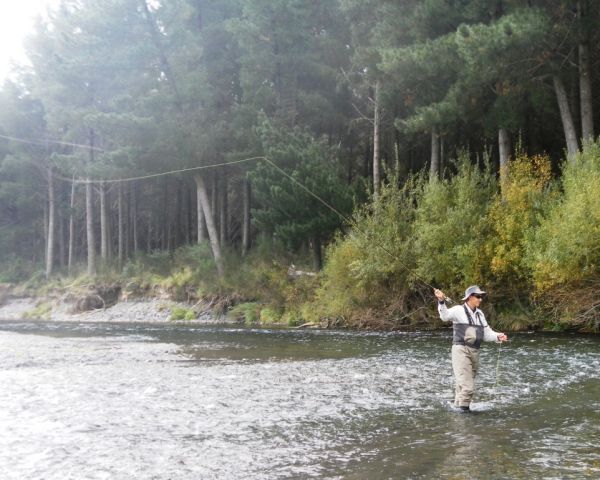 Beginners new to the sport of fly-fishing face a mine-field of confusing choices. One of these is which fly-line to purchase. Nowadays it really only comes down to Double Taper or Weight Forward and most seem to choose the latter. Below is a very quick guide to help explain some of the pros and cons of both. Beginners new to the sport of fly-fishing face a mine-field of confusing choices. One of these is which fly-line to purchase. Nowadays it really only comes down to Double Taper or Weight Forward and most seem to choose the latter. Below is a very quick guide to help explain some of the pros and cons of both. 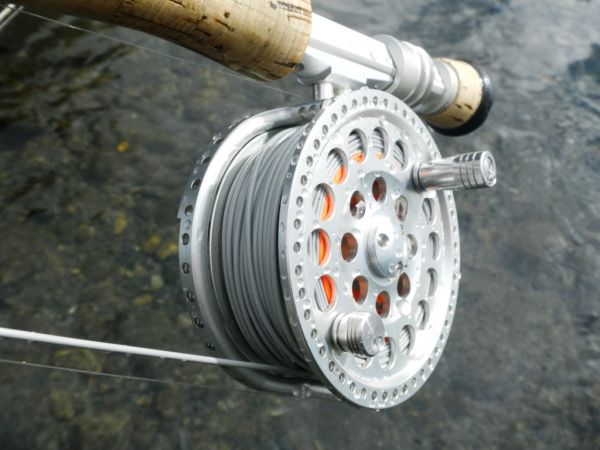 The Double Taper line consists of one long belly with an identical taper at both ends and is generally considered a better option for spey and roll casting techniques. Some anglers find it a more pleasant line to handle and control especially when mending. If your fishing on a budget another advantage is that they are reversible when one end becomes worn or damaged. The Double Taper line consists of one long belly with an identical taper at both ends and is generally considered a better option for spey and roll casting techniques. Some anglers find it a more pleasant line to handle and control especially when mending. If your fishing on a budget another advantage is that they are reversible when one end becomes worn or damaged.
The Weight Forward profile is more complex and starting at the reel has a thin level section called the running line.The length of this section varies but typically may be 10 meters depending on the manufacturer. Eventually this increases in thickness and forms the section called the the rear taper. This is the part of a line which helps with the smoothness of a cast, the longer the rear taper the better the distance and control during the cast. Short rear tapers get the line moving much more quickly for faster casts. 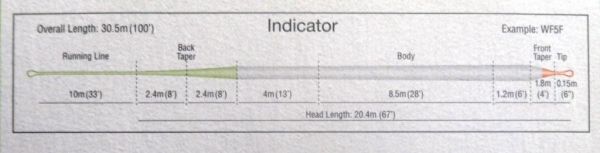 The rear taper is followed by another level thicker section called the belly. This is the heaviest part of a fly-line and carries most of the energy during a cast. Longer bellies give smooth long casts but you have to be be able to keep the line in the air and are better suited to more experienced anglers. The rear taper is followed by another level thicker section called the belly. This is the heaviest part of a fly-line and carries most of the energy during a cast. Longer bellies give smooth long casts but you have to be be able to keep the line in the air and are better suited to more experienced anglers.  Short bellies shoot better and cast quicker but presentation and line control at distance is compromised. The belly gradually decreases in diameter to form the front taper, followed by a shorter thin level section called the tip. This is where you attach your leader. Some lines come with a factory welded loop or you can use anyone of half a dozen other methods to connect them. The combination of rear taper, belly, front taper and tip is called the head. Varying the lengths of these tapers mean manufacturers can design lines with very different casting properties. Modern Weight Forward lines come in different profiles and have heads of varying lengths. Short bellies shoot better and cast quicker but presentation and line control at distance is compromised. The belly gradually decreases in diameter to form the front taper, followed by a shorter thin level section called the tip. This is where you attach your leader. Some lines come with a factory welded loop or you can use anyone of half a dozen other methods to connect them. The combination of rear taper, belly, front taper and tip is called the head. Varying the lengths of these tapers mean manufacturers can design lines with very different casting properties. Modern Weight Forward lines come in different profiles and have heads of varying lengths.
A long head will give better control at distance but may need more false casting while a shorter head will clear the guides more quickly. I have used WF lines with short heads in a very different fly-fishing life back in the UK. But that was when fishing from the shore on large still-waters where distance was important and mending wasn't such an issue. They are easier to shoot because most of the mass of the line is up front and has the effect when cast of literally towing the very thin running line through the guides. However effective mending at distance can be impossible because you are trying to move the heavy belly with the much thinner running section, on the Tongariro they would be next to useless. Some brands that have very thin running lines are also prone to tangles. I prefer a line that has a long head section with a running line that is not too thin and rarely get problems. So if your new to fly fishing it may be better to opt for a WF line with a medium head length which needs less false casting to deliver the flies but will still afford you a reasonable amount of line control as your distance improves. 
Most beginners find it easier to learn with a weight forward line because they are simpler to cast and the heavier belly enables a novice to "feel" the line loading the rod. Many weight forward lines also have front tapers that are specifically designed to "turn over" heavy flies which is a huge advantage for winter fishing on a river like the Tongariro. Your choice of line will also depend at what distance you routinely fish but I would suggest that most of the time this would probably be much less than say 50 feet. If that is indeed the case then even when using a WF line with a medium to long head length the running line wouldn't be on the surface that often, making mending easier. Judging by line sales anglers find that WF lines are versatile enough and will cover most situations but as always in fly fishing it all comes down to individual choice. If you think about it no one line is capable of performing all tasks perfectly and most of the time whichever line you eventually favor it would be a bit of a compromise.
Tight Lines
Mike |
|
|
| Back to Top |
|
|
|
|
|
|
|


