| |
|
|
| |
Nymphing Part Five.
Fri 25th May, 2012
|
|
|
|
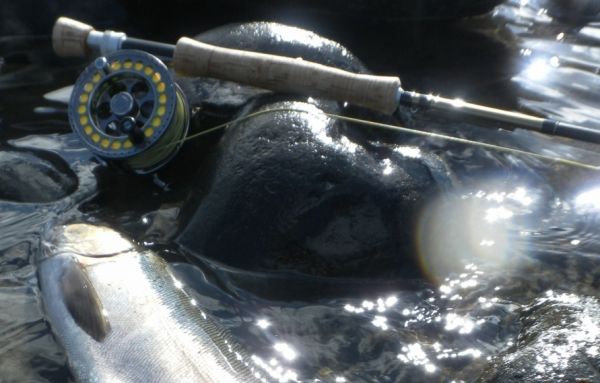
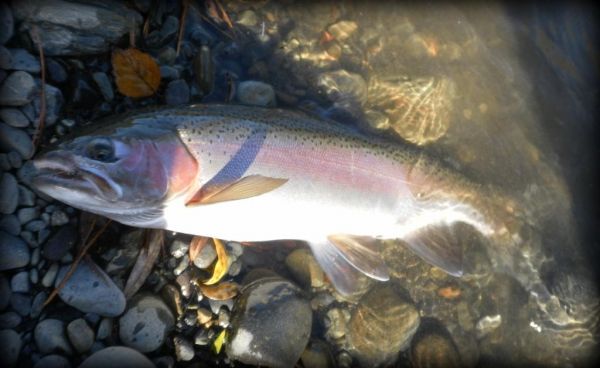
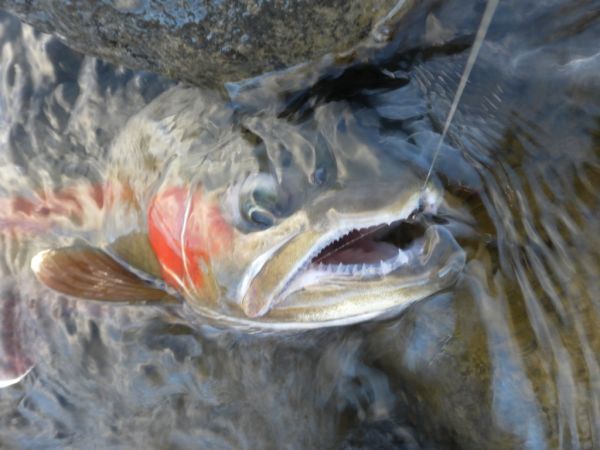
At last I've managed to get in some serious fishing and with morning frosts and cold southerly breezes I couldn't have timed it better. The fish seem evenly spread throughout with relatively few anglers chasing them and the falling temperatures bring with them an expectation that the current small runs will continue, gradually building until they peak later on in the year. I'm always a little wary writing a report after spending only three days on the river because if you catch the Tongariro in a good mood its easy to get over excited ... but its been an awful lot of fun. I've landed and been beaten up by some hard fighting rainbows that already look to be a notch or two up on recent years.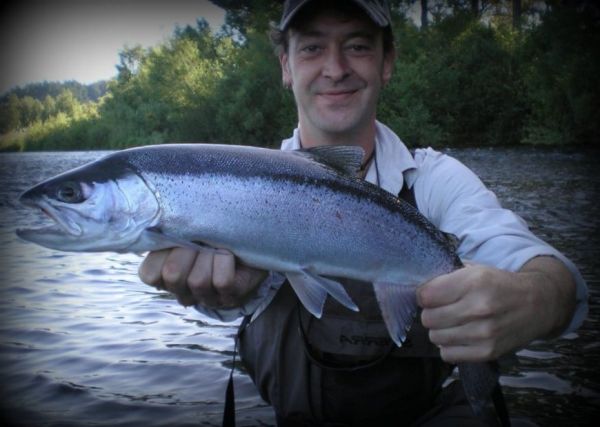 There's still a little way to go before we get back to a river full of fish like this one caught a few years ago but personally I think things are looking really good and we're on an upward trend. I've spoken to visiting anglers from all over the place and although their success rate varied the consensus seemed to be that they were having a good time and enjoying the late autumn sunshine. There's still a little way to go before we get back to a river full of fish like this one caught a few years ago but personally I think things are looking really good and we're on an upward trend. I've spoken to visiting anglers from all over the place and although their success rate varied the consensus seemed to be that they were having a good time and enjoying the late autumn sunshine.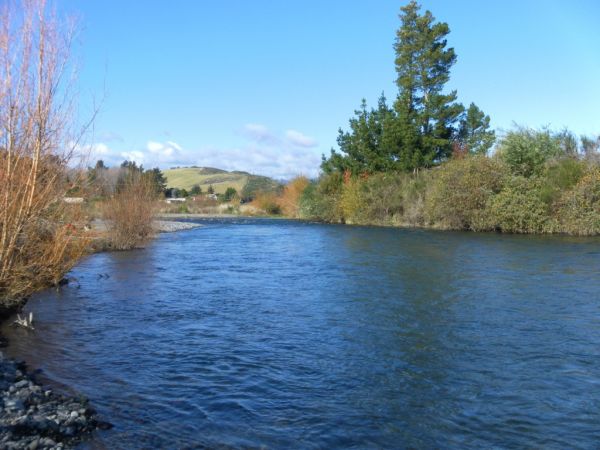 I was on the river just before dawn each morning because I wanted to secure a particular spot in whats left of the Braids. Its never been everyone's cup of tea but the old saying " if you want scenic go upriver, if you want fish then go to the Braids " is pretty accurate. Its a shame that anglers had to lose so much good, easily accessible water but the fifty thousand or so fish that run the river annually still have to pass through this stretch. There's very little holding water left so they don't hang around for long. But if you think back that had been the case for the last couple of years well before they turned it into a bomb-site. You are limited to only a few spots that are worth fishing so set the alarm and get your flies through first and then move on. Data gathered by monitoring migrating trout indicate that most of their upstream journey takes place each day between midday and midnight. They sit tight between 12.00 pm and 4.00 am with more movement occurring in the late afternoon between four and eight pm. At first light there is a short-lived period of activity as fish move through again, which usually only lasts an hour or two but is worth targeting. Notice that I mentioned flies earlier not globugs, anglers associate late autumn and winter with bombs and bugs but with the low clear conditions it was caddis or small nymphs fished on a lighter set-up that scored best. I only took two fish on globugs in three days because this trip ... the trout ... or more likely the angler ... developed a preference for orange flies and I did well here with both a czech nymph and one of my epoxy efforts tied in this color. I was on the river just before dawn each morning because I wanted to secure a particular spot in whats left of the Braids. Its never been everyone's cup of tea but the old saying " if you want scenic go upriver, if you want fish then go to the Braids " is pretty accurate. Its a shame that anglers had to lose so much good, easily accessible water but the fifty thousand or so fish that run the river annually still have to pass through this stretch. There's very little holding water left so they don't hang around for long. But if you think back that had been the case for the last couple of years well before they turned it into a bomb-site. You are limited to only a few spots that are worth fishing so set the alarm and get your flies through first and then move on. Data gathered by monitoring migrating trout indicate that most of their upstream journey takes place each day between midday and midnight. They sit tight between 12.00 pm and 4.00 am with more movement occurring in the late afternoon between four and eight pm. At first light there is a short-lived period of activity as fish move through again, which usually only lasts an hour or two but is worth targeting. Notice that I mentioned flies earlier not globugs, anglers associate late autumn and winter with bombs and bugs but with the low clear conditions it was caddis or small nymphs fished on a lighter set-up that scored best. I only took two fish on globugs in three days because this trip ... the trout ... or more likely the angler ... developed a preference for orange flies and I did well here with both a czech nymph and one of my epoxy efforts tied in this color. 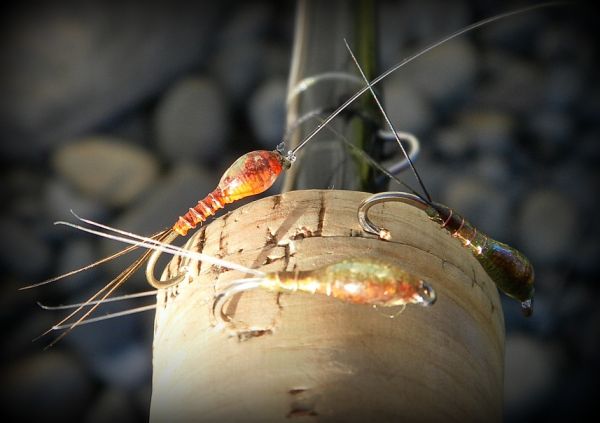
Before I forget if anyone has lost a fly rod and reel lately there's one sticking out of the water on the true left bank of what used to be the Honeypot. If you fancy trying to retrieve it take a rope with you because its about twelve feet from the bank stuck in deep water amongst submerged tree roots.
I only fished Judges once because I wanted to try a couple of spots upriver that I hadn't been too for a while but it was worth the visit. As expected there were already anglers there when I arrived but as I walked past them they invited me to fish above them in the broken water at the head of the pool.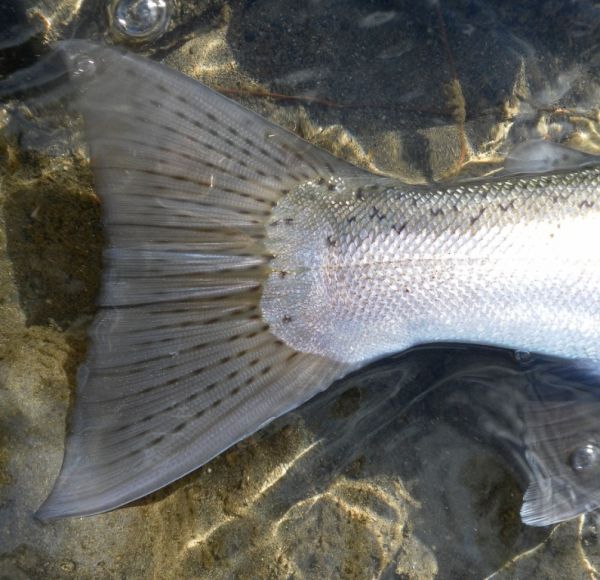 This was very much appreciated because its a favorite spot of mine and I'm usually pretty lucky here. A cast or two later the indicator fly dipped once then shot under and I found myself playing a silver hen with a propeller of a tail that really tested the lighter gear in the fast water. After taking a couple more the others came up to ask what I was using and we ended up having a good ole chin-wag. Tony was from Perth in the middle of his first trip for over six years and couldn't believe how much the river and the fishing had changed. I think his first words were " this is not the pool it was " and This was very much appreciated because its a favorite spot of mine and I'm usually pretty lucky here. A cast or two later the indicator fly dipped once then shot under and I found myself playing a silver hen with a propeller of a tail that really tested the lighter gear in the fast water. After taking a couple more the others came up to ask what I was using and we ended up having a good ole chin-wag. Tony was from Perth in the middle of his first trip for over six years and couldn't believe how much the river and the fishing had changed. I think his first words were " this is not the pool it was " and
he was right things have altered. Of course he meant it doesn't produce like it used to and again he was right. Sometimes it pays to re-think your approach and adapt to the changes. I know that I fish the Tongariro in an entirely different way than I did a few years ago.
Its never the same one year to the next which is why I've always found this river so interesting.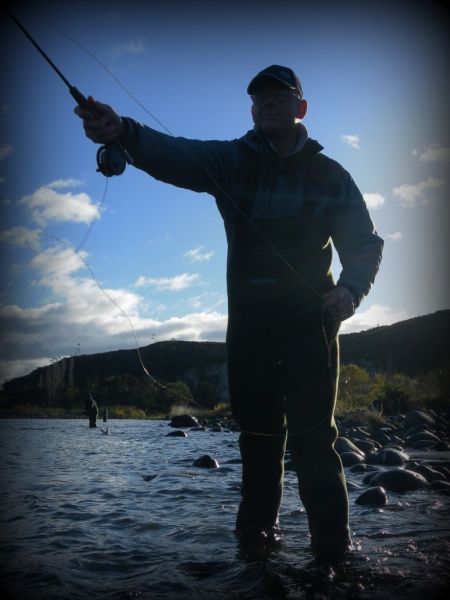
Andy was from that other island to the South of us on a weeks poaching trip and had never fished the Tongariro. He was surprised that the fish were taking small naturals because he had been advised to stay away from nymphs and only use globugs. Before moving on I couldn't resist setting him up differently, hopefully he caught some fish so that when he gets home he can tell the other poachers down there how good the Tongariro is. On my last morning
I hooked up to some fit deep bodied jacks and typical of male rainbows they attempted to bully you from the moment you struck. All of them came from one stretch with deceptively fast flowing water between me and the fish. It was lucky I was using the 8 wt and indicator rig in here because a couple of times I had to chase fish downstream in order to land them. Talking to others my impression is there are fish right through from the bottom of Grace Rd to the Upper reaches. I spoke to one angler who had caught his share of rainbows and a 9 lb brown wet-lining the Hydro and I bet that won't be the only one this week. Not that many anglers around and with a cold settled spell until Sunday, then showers for the early part of next week it should be good.
Regular visitors to this site may have noticed that some of the weather data on the info page is no longer functioning properly. This information is kindly supplied by River Birches Fishing Lodge and this site is one of several that are also allowed to use their live River Cam feed. I've had a number of emails from anglers inquiring about the problem but I'm not sure exactly what has happened, judging by the amount of hits I get on the info page I'm not the only one who finds this information useful so why not flick an email to enquiries@riverbirches.co.nz and let them know how much you miss it.
Now for the penultimate part of the Nymphing series ... I was going to say "last but one" but penultimate sounds better. Originally I intended this quick guide for beginners to be spread over a couple of weeks, I obviously talk too much because its dragged on and on ... this time ... mending.
CONTROLLING THE DRIFT.
Whichever method you choose when upstream nymphing if it involves the use of a floating line then you will have to learn how to control and make adjustments to the fly line as it travels downstream. We call this technique " mending " and our goal is to get the nymphs to drift past feeding trout in a manner which to them looks natural and doesn't arouse suspicion. You can learn to become the most proficient caster on the planet and rig yourself out with the best equipment money can buy but if you can't " fish " those flies you'll be wasting your time and money. Although I'm a firm believer that we sometimes credit fish with far more intelligence than they actually have ... they are not stupid and instinctively know when something is not quite right. For instance the nymphs and larvae they live on don't usually shoot past them at a hundred miles an hour nor do they suddenly stop dead and hover in the current but if you don't mend properly these are just a couple of examples of un-natural behaviour which could make a trout hesitate and refuse your flies. Even with good line control, during a normal drift your flies only behave like the natural insects for a relatively short time and as soon as you cast out that clock is ticking. I'm not quite sure how they did it but someone worked out that during the average 30ft cast, by the time they sink, they will look just like the natural insects for about three feet, something like them for about fifteen feet and bugger all like them for twelve feet ! 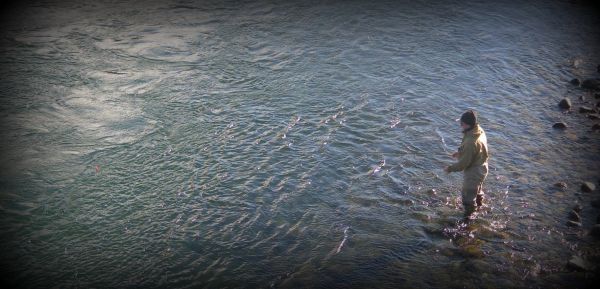 So you can see the importance of effective mending for realistic presentation. When upstream nymphing with an indicator we are trying to convince the trout that the nymphs are drifting downriver unattached to a line. This would be fairly easy if the river flowed at a uniform speed across the surface and down through the water column ... but it doesn't. Friction causes the water at the bottom and sides to travel more slowly than the water at the surface or middle of the river. If we did nothing after casting, the fly line would quickly be forced into a downstream bow, dragging the indicator and leader with it, stopping the nymphs from ever reaching the river-bed. Mending is the technique we use of intentionally repositioning the line and sometimes the indicator to lessen the effect the current has on the fly line and help prevent the nymphs from dragging. So you can see the importance of effective mending for realistic presentation. When upstream nymphing with an indicator we are trying to convince the trout that the nymphs are drifting downriver unattached to a line. This would be fairly easy if the river flowed at a uniform speed across the surface and down through the water column ... but it doesn't. Friction causes the water at the bottom and sides to travel more slowly than the water at the surface or middle of the river. If we did nothing after casting, the fly line would quickly be forced into a downstream bow, dragging the indicator and leader with it, stopping the nymphs from ever reaching the river-bed. Mending is the technique we use of intentionally repositioning the line and sometimes the indicator to lessen the effect the current has on the fly line and help prevent the nymphs from dragging.
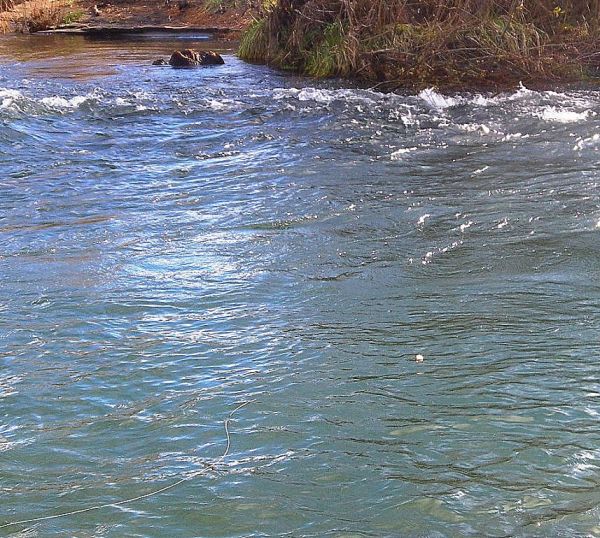 The first mend is probably the most important, setting everything up for the rest of the drift and is best carried out as soon as the line hits the water. The mend itself begins by raising the rod tip to lift the fly line off the water and then rolling the wrist in a semi-circular motion in the direction you want to place the mend, this flips the line and forms a large upstream curve. The first mend is probably the most important, setting everything up for the rest of the drift and is best carried out as soon as the line hits the water. The mend itself begins by raising the rod tip to lift the fly line off the water and then rolling the wrist in a semi-circular motion in the direction you want to place the mend, this flips the line and forms a large upstream curve.
On this first mend I prefer to move the indicator upstream as well. By repositioning it upstream of where the flies landed you will immediately introduce slack into the drift allowing the nymphs more time to get down because you have temporarily eliminated drag on the leader.
This is the only time I'll deliberately move the indicator { unless I'm fishing close in } because if you try it again at distance you'll pull it and the flies towards you, lifting them off the bottom and away from the feed lane. The key to a good drift is to keep that slack in the system as long as possible by throwing a series of smaller mends either up or downstream as everything travels down river. Eventually the indicator and line will catch up and overtake the nymphs no matter what you do. But you can squeeze another few meters by throwing a few downstream mends before everything really tightens up and you have to start again. Mending is a complex but vital part of fly fishing and probably more difficult to master properly than casting. This has been a very basic introduction for beginners, covering just one aspect of line control, in this case when nymphing with an indicator.
Its a huge subject because every new fishing situation or method requires a different mending solution. The best way of learning is to find a quiet spot on the river away from other anglers and practice ... who knows what could happen as those nymphs travel back downriver towards you.
Tight lines guys
Mike |
|
|
| Back to Top |
|
|
|
|
|
|
|


