| |
|
|
| |
Nymphing Part Six
Fri 8th June, 2012
|
|
|
|
Nothing causes more confusion for new fly fisher's than the design and function of the leader/tippet and many mistake tippet and leader as meaning the same thing. Good fly fishing leaders are always tapered but there are exceptions as we'll see later. Most people choose from three basic types ... Braided tapered ... knot-less one piece tapered or compound tapered which are made by knotting together successively thinner level lengths of mono. By mixing and matching various lines compound leaders can be designed to behave differently for specific fly fishing situations and are a science in themselves. There's even a web-site with a free download called "LeaderCalc" www.globalflyfisher.com which promises us " the most comprehensive tool for calculaing classical and contemporary leaders-and designing your own formulas for knotted leaders " so no more excuses for our flies "alighting" like a pile of spaghetti in the middle of the river. A well designed fly fishing leader has to perform several important functions.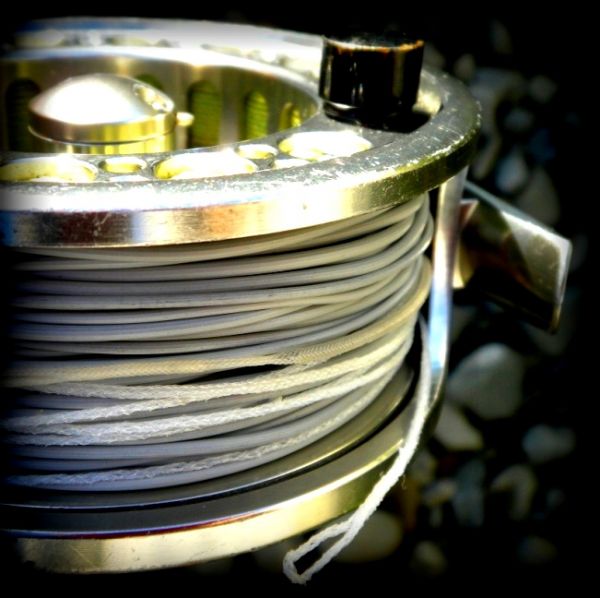
As we cast it should help tranfer energy from the fly-line to " turn over " the artificials so that they land quietly onto the surface. It provides a less visible link between the thick easily seen fly-line and the fly and puts distance between the two so that fish are less likely to spook. Finally the leader should enable the fly to drift unhindered without dragging as it travels downstream. Whether you hand tie your own or choose one of the many types of commercially available products a properly constructed tapered leader is basically made up of three sections, each one with a very different role. The "Butt" is the thickest part and is connected to the end of the fly-line to ensure a smooth transfer of the energy built up during the cast. The " Mid " or "Transitional " section helps continue that process to achieve the desired presentation of the fly. Then lastly the " Tippet " which is the thinnest part and where we attach the flies or adjust the length of the leader.
Most of what we've discussed so far and a lot of what follows mainly applies to the construction of leaders for situations where a more delicate presentation is required. But three common leader types needed for the Tongariro would include the following :
For sinking lines and large streamer type flies a leader that straightens quickly and puts you immediately in touch with the fly is best. Faced with this situation most would go for a short tough leader made from a single length of fairly stiff line.
Small dries that need to be presented in a more natural manner and dead-drifted without drag across changing surface currents will be easier to control with a long thin leader constructed out of softer, much more flexible materials.
For general purpose nymphing the leader needs to be durable and long enough to allow the nymphs to reach feeding trout quickly. It would also help if it was designed so that less of the thicker butt section lies below the surface during the drift, where the effect of the current dragging on the heavier line would hinder its descent. You don't really need a traditional tapered leader for heavier nymphs because any hope of delicate presentation goes straight out of the window as soon as you add weight to the equation. 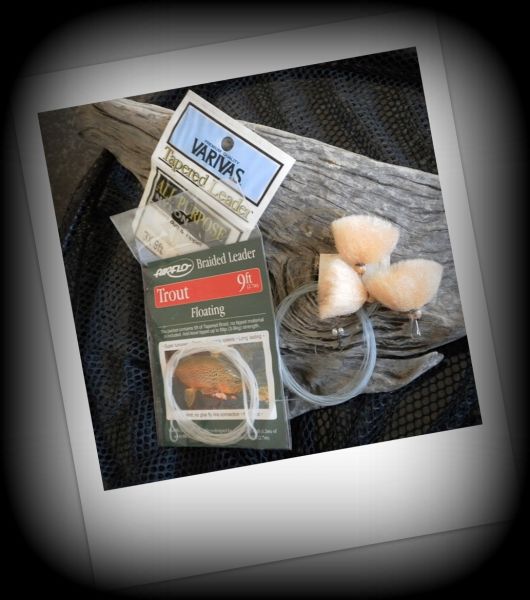
Another aspect of leader design that beginners are unsure of is how long to make each of the three main sections that together make up a tapered leader ie; Butt, Mid-section and Tippet. There are all kinds of weird and wonderful formula's out there but if you want to keep things simple just remember the good ole
50% ... 25% ... 25% method which is one that has served anglers well for years.
The leaders I prefer on the Tongariro are pretty straight forward affairs, do what they need to and sometimes even help catch a few fish. For dry fly fishing I use a 5 ft AirFlo leader made from tapered braid to which approx 6 ft of suitable mono is attached with a simple loop to loop connection.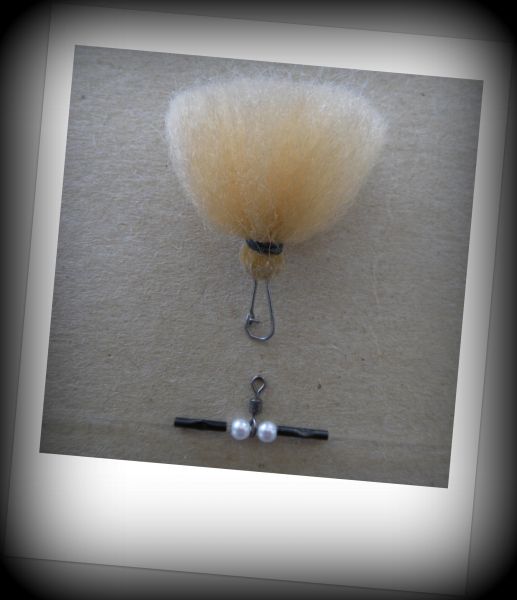
The diameter of the mono will be dependent on the size of the fly and whether or not I'm using a dry and dropper nymphing rig. When nymphing with the indicator I use 5 ft of fifteen to eighteen pound Maxima for the butt section which is again connected to the fly line loop to loop, it also carries my sliding indicator setup. This is made using a couple of rig crimps, two small beads and a swivel and once crimped correctly easily slides up or down for instant depth adjustment. To the other end is attached another tiny swivel which gives me a convenient connection point for the remaining 8 ft of the leader/tippet. I used to make this bit using equal lengths of 10 lb and 8 lb Maxima Ultragreen but nowadays use only the latter to which I attach the bomb. I carry several butt sections made up with the
" indicator carrier " already in place so in the unlikely event I have to replace this part of the leader its a quick and easy change over.
So far we've managed to keep things fairly simple but leader/tippets aren't only measured in terms of length ... now the dreaded X factor!
The in depth explanation below was written a couple of years ago by an author with the username
" morilla " and is one of the better ones I've found so far :
UNDERSTANDING THE X FACTOR IN LEADERS AND TIPPETS.
" Most fishermen are accustomed to identifying ‘fishing line’ by its “pound test” rating; i.e., the breaking strength. In flyfishing, leader and tippet material are primarily designated by their diameter. While this can be used to infer an approximate breaking strength range, in reality, the diameter does not, of necessity, translate into a specific “pound test” designation.
Without going into the historical context, let’s just say that tradition is a very potent force in the sport which is flyfishing. On occasion, efforts have been made to mitigate some of the impacts of this force when it comes to modern technologies and consistency in the marketplace. For instance, manufacturers are currently – or, I should say, “once again” – attempting to move away from the “ought” (e.g., 12/0, 10/0, 8/0, 6/0, 3/0) designation for fly tying threads. Simply put, one manufacturer’s 6/0 tying thread is not representative of another’s in terms of strength, diameter, or how it lays on a hook.
The same type of potential ‘inconsistency’ is actually part of where the “X” designation stems from in leaders and tippets used in flyfishing. When referring to the diameter of these materials, the actual measurements are in thousandths of an inch. In that context, it is simply much easier to reference a leader/tippet as, say, “5X” than “6 thousandths (.006) of an inch in diameter.”
In mathematical terms, the “X” label is not a ‘factor,’ it is a ‘constant’ derived from a specific reference or base. Without getting lost in the historicity surrounding how this constant was created (think silk gut used prior to monofilament), let’s simply stipulate that in this equation…
“X” = 11
The base, or reference point, is that "0X" leader/tippet material is 0.011 inches in diameter. Any leader or tippet smaller in diameter is designated by a number which is then subtracted from the base number of 11 to indicate the material’s diameter. Sound complicated? It’s not… Really.
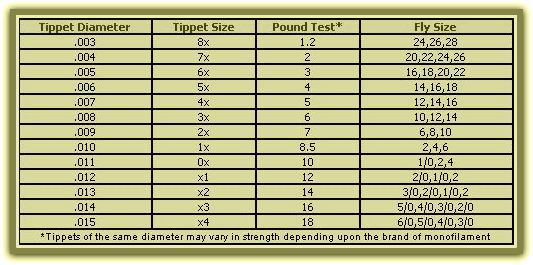
Take the 5X material I cited a moment ago. I said it was easier than saying it was “6 thousandths (.006) of an inch in diameter.” If you don’t already see how it works, try this…
Take the constant of 11 and subtract 5… i.e., 11 – 5 = 6.
Now, remember this is a designation in thousandths of an inch; thus, the “6” actually means 0.006 inches in diameter.
If you’re still having trouble, try it using the decimal places…
0.011 – 0.005 = 0.006
Put into words, “5X” means that the material is five thousandths of an inch smaller in diameter than the reference point of “0X.”
The smallest, practical size of leader/tippet material generally available is “8X;” which has a diameter of 0.003 inches. (11 – 8 = 3 … OR… 0.011 – 0.008 = 0.003) There are smaller diameters out there; but, they aren’t very practical from the standpoint of turning over a fly of any size on a cast and in terms of…
Strength
As stated, leader/tippet material used for flyfishing typically has a higher strength-to-diameter ratio than standard fishing line. This is important when working with material smaller than “OX.” Why?
One of the key factors in getting fish to take flies is in the presentation of that fly as something that looks like a natural food source. If the line attached to the fly is too large or too stiff, the fly looks anything but natural; e.g., it doesn’t drift appropriately in the current. This is one of the reasons flyfishers tend to use the smallest diameter leaders and tippets they can given a variety of factors such as type/size of fly, species/size of fish, wind, etc. As a result, manufacturers of leaders/tippets intended primarily for fly angling are constantly striving to make smaller diameter materials stronger.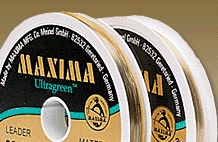
As an example, let’s take the ever popular Maxima Ultragreen monofilament. In that brand, you can obtain a 110 yard spool rated at 4 lb. test strength, depending on your source, for around $7 - $10.
The diameter of this 4 lb. test is 0.007 inches, which would designate it “4X” (11 – 4 = 7 or 0.011 - 0.004 = 0.007) in flyfishing terminology. Without picking on a specific manufacturer, a 30 yd. or 30 meter spool of “4X” flyfishing monofilament tippet will run around $4 - $8. However, the test strength will run between 6 and 6 ½ pounds; i.e., half again or more stronger than the Ultragreen for the same diameter.
Put another way, if you were willing to fish with 4 lb. test tippet material, you could drop at least one “X” size smaller (5X) in diameter; a potentially crucial factor when dealing with spooky fish. Remember, you are trying to emulate the trout's natural diet with your flies. You want the flies to both look and act naturally as they drift with the current. See it from the trout's perspective. How many mayflies or caddis do you see with a "rope" sticking out of their heads? How "naturally" does a fly float when attached to a stiff piece of monofilament?
If you were willing to pony up for fluorocarbon material made specifically with an eye toward flyfishing, the difference becomes even starker. Both Umpqua’s SuperFluoro tippet and Rio’s Fluoroflex Plus tippet, in “4X,” have listed test strengths of 7 lbs. Think about that for a moment.
To get the same, relative test strength from Maxima Ultragreen, you have to upsize to 0.009 (6 lb.) or 0.010 (8 lb.) or a 2X and 1X diameter respectively. That’s a BIG difference when it comes to fly angling.
Going the Other Way
Interestingly, the “X” designations don’t go very far in the ‘other’ direction; i.e., larger than “0X” (0.011 inch diameter). From a certain perspective, the reason is simple. Once you get above a certain diameter, the test strength becomes the critical factor while the concept of a ‘natural’ presentation tends to become less critical. Generally speaking, you are venturing into big fish and big fly territory.
Insofar as this discussion is concerned vis a vis the “X” factor, the important thing to bear in mind is that leaders and tippets larger than “0X” (0.011” diameter) are designated with the “0” and an additive. In other words, rather than subtracting, as with smaller diameters, you add the number to the “OX” base.
For example…
The next size leader/tippet larger than “0X” is “01X.” So, you start with the base number, "11" (0.011). Then you add "1" (0.001)...
11 + 1 = 12 … OR … 0.011 + 0.001 = 0.012
“02X” should be… 11 + 2 = 13 (0.013”) and so forth.
The problem is that, once again, we start to venture into a bit of a ‘gray area’ when it comes to manufacturers and ‘standardization.’ While those sizes smaller than “0X” are all supposed to be ‘uniform’ in diameter, there are minor differences; e.g., while 4X is standardized at 0.007” in diameter, that’s an average. Actual sizing can vary. I once did a test run of several manufacturers a couple years ago and found that 4X tippet material ranged from 0.00674” – 0.0074” in diameter; with one company, which shall go unnamed, making me wonder how they were getting away with their “X” designations. In fact, the variances weren’t just between manufacturers, but occurred between series from the same manufacturer.
When looking to leader/tippet material larger than the base measure (“0X”), such variance becomes even more pronounced. Why? Remember, once you decide to “go big or go home,” you’re pretty much throwing “subtle” out the window. Thus, the emphasis becomes focused more on strength than on maintaining a high strength-to-diameter ratio. This is part of the reason why you will generally see, with a few exceptions, the “X” designation stop once you hit about “03X.”
Some Final Thoughts
A spool of tippet material will be uniform throughout the entire length. A tapered leader will derive its “X” designation based on the diameter of its "tip" at the smaller end. This means that you must select your tippet material based on the "X" size of the leader you'll use; e.g., the largest tippet material you can use with, say, a 4X leader is 4X tippet. You can, in theory, however, effectively use three "X" sizes of tippet for a given "X" leader size… IF what you're solely matching diameter and not test strength. As a practical matter, you don’t want your tippet to be stronger than your leader.
For example, you wouldn't want to use 4X fluorocarbon tippet (7 lbs.) on the end of a 4X monofilament leader (6 lbs.).
When attempting to decide which size tippet material you wish to use for a given fly size, remember the number “3.” Let’s say you are tying on a size 12 fly. Divide 12 by 3. This gives you “4.” Care to guess which “X” size this indicates?
Generally, you can get away with 1X smaller or larger using this method. In other words, for the size 12 fly, you can use 3X, 4X, or 5X tippet. Bear in mind, however, that this is just a general rule of thumb. There are plenty of times when I’ve fished size 12’s on 6X and even 7X or size 18’s on 4X tippet. This method just gets you into the ballpark in terms of what most hook eyes will comfortably accommodate.
Truth be told, even most flyfishers don’t think in these terms. They tend to think in terms of the ‘size’ (“X”) that works on the particular water they’re intending to fish or would be consistent with the methodology they intend to employ. Be that as it may, I hope I’ve provided a little better understanding of this ‘system.’ In the end, understanding is better than guessing ".
Right! stop scratching your heads and put your calculators away. Unfortunately I've been tied up again with hospital appointments, more tests and I'm convinced my left arm is supplying the Emergency Department at Wellington Hospital with blood but next week is looking good so with a bit of luck I'll be out and about and will let you know if anything exciting happens. In the meantime remember;
" The fly angler who says they have never fallen in while wading is either a pathogenic liar ... or has never been fly-fishing. "
Jimmy Moore
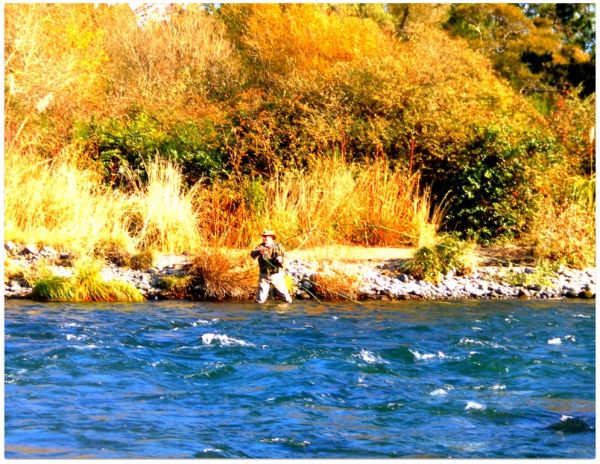
The complete six part series on tips for nymphing the Tongariro is available over in the Quick Guides section all conveniently stuck onto one page at no extra charge, just click on the link top left.
Tight Lines Guys
Mike |
|
|
| Back to Top |
|
|
|
|
| |
| COMMENTS |
|
Is that a backhand cast in the last photo?
psgood luck with the medics |
|
|
|
| Que? | Sun 10th June, 2012 | View 2 Replies |
|
|
|
| |
|
|
|


