| |
|
|
| |
Repairing a fly line loop.
Wed 18th July, 2012
|
|
|
|
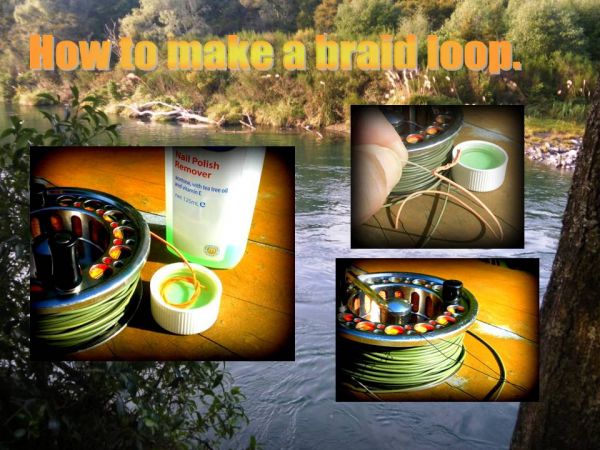
Many fly lines come complete with a factory welded loop but eventually they will wear and break down ... if your a beginner don't despair, this is one of several ways to easily fix a broken loop.
During the late 1940's through to the 1960's there were huge advances in the design and manufacture of the early plastic coated lines which paved the way for the fly lines we use today.
Up until then it was the braided nylon core that formed the lines taper which was then covered with a plastic outer coating. This was an expensive and labor intensive process using specially adapted braiding machines and even with skilled operators each one could only produce about eight lines per shift. The biggest change occurred in the mid-fifties when mad keen fly fisher's and founders of "Scientific Anglers" Leon Martuch, Paul Rottiers and Clare Harris began experimenting with different coatings.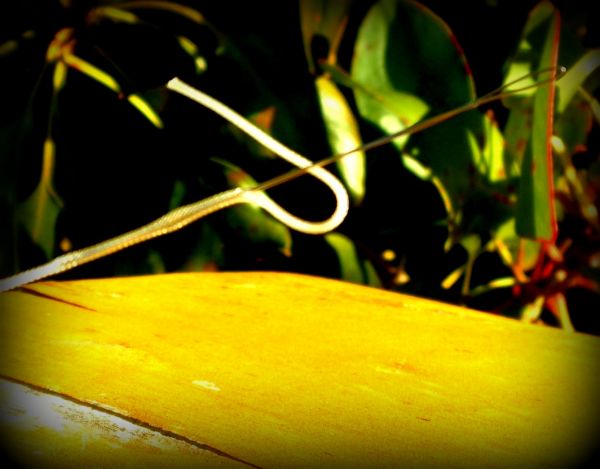
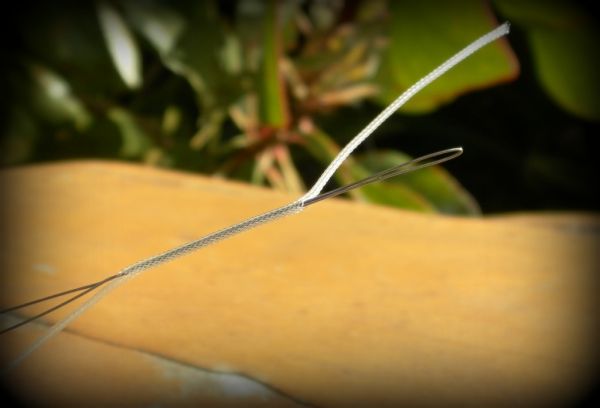
The breakthrough came when they invented a process of forming a tapered coating over a level braid core, instead of the other way around. This was a less labor intensive and much more cost effective method of making a fly line. Other companies quickly followed suit and came up with their own methods which in turn started a " line war " as manufacturers raced to develop all kinds of specialized fly lines to increase their market share. Nowadays we have lines for " every occasion " something that would have been impossible with pre-1950's production methods.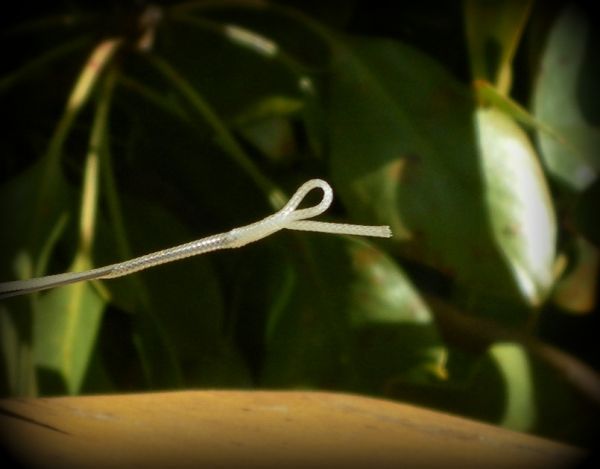 We can use the braid center of the line to create a new loop. All you need is some acetone or nail varnish remover, a wire bobbin threader, Aquaseal or any flexible urethane repair adhesive and a pencil. First of all make sure your line has a braided core, some budget lines don't. If you can't determine this by inspecting the damaged loop end use the steps described below to remove some of the coating on the reel end. This will save your front taper and give you a little bit of practise. When your ready to start cut off the broken loop and place the end of the line in the acetone for approx 20 to 30 seconds. We can use the braid center of the line to create a new loop. All you need is some acetone or nail varnish remover, a wire bobbin threader, Aquaseal or any flexible urethane repair adhesive and a pencil. First of all make sure your line has a braided core, some budget lines don't. If you can't determine this by inspecting the damaged loop end use the steps described below to remove some of the coating on the reel end. This will save your front taper and give you a little bit of practise. When your ready to start cut off the broken loop and place the end of the line in the acetone for approx 20 to 30 seconds. 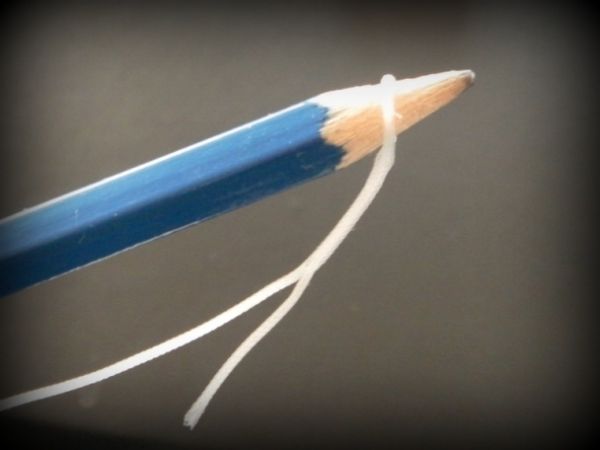 This helps soften the outer coating. Using your thumbnail remove a few inches of the plastic to reveal the nylon braid. Insert the tip of the threader into the center of the core a bit like sticking a needle into a vein and as close to the outer coating as you can get it. Push the threader about 3/4 of an inch up the center of the braid and then exit it through the side. Thread the tag end of the exposed braid into the bobbin threader and begin to pull it into the core. This helps soften the outer coating. Using your thumbnail remove a few inches of the plastic to reveal the nylon braid. Insert the tip of the threader into the center of the core a bit like sticking a needle into a vein and as close to the outer coating as you can get it. Push the threader about 3/4 of an inch up the center of the braid and then exit it through the side. Thread the tag end of the exposed braid into the bobbin threader and begin to pull it into the core. 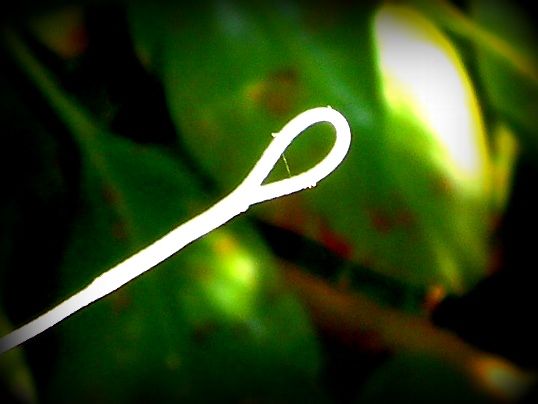
At this point insert a pencil into the partly formed loop to stop it closing completely then ease the rest of the tag end into the core and out through the side of the braid. Trim off the excess tag then apply some Aquaseal starting from the fly line to the base of your new loop. Wet your fingers and smooth the adhesive into the braid then leave it for approx 24 hours before you use it. The images show how to create a loop in any length of braid. In a future article we'll look at how to fit a home made or shop bought braided loop to a fly line that doesn't have a braid core.
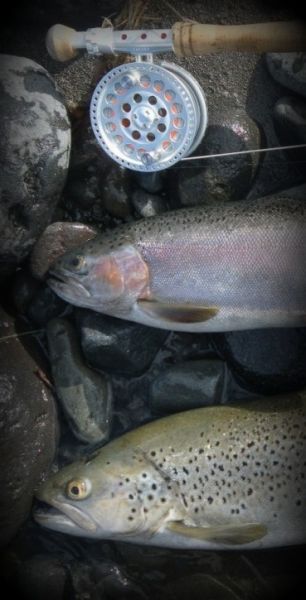
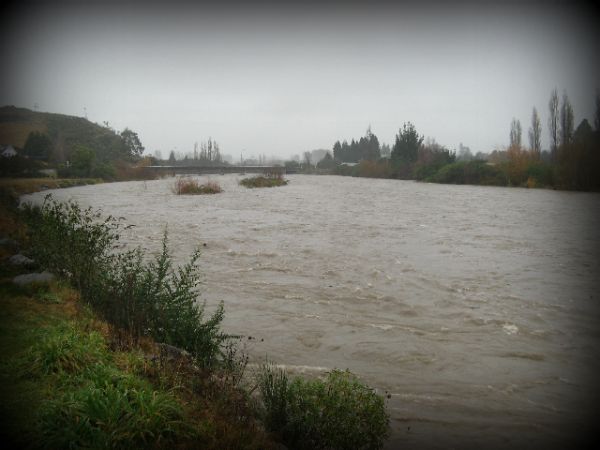
The river peaked at 600 cumecs but has fallen rapidly over the last couple of days and is currently flowing at a very fishable 55 cumecs. This is just what we needed and will definitely shake things up a bit. Tongariro regulars know only to well that in recent years the timing of the annual runs and the way both species behave while in the river has been changing.
I was looking at some of the reports written last year, if your interested scroll up, click on 2011, then the month you're after. The Tongariro spawning runs have become very unpredictable and are never the same two years on the trot. Temperature, biological history, rainfall, all play a part but there are " trends " you can pick up on and there was some better fishing during the second half of this month last winter see " Some good fish around ". My best rainbow of last year was caught in July ... unfortunately it came from the Braids, although I'm sure there will be some big changes over there after this flood. The first significant rainbow trout runs of 2011 and from memory 2010 turned up during the last two weeks of July with August through to October the most consistent months ... so we'll see. I'm not out again until Friday, by then things should have settled back giving perfect conditions. With the forecast looking good from mid-week on, the Tongariro could switch on big time in the lead up to the weekend ... I'll let you know ... unless I get skunked!
This has gotta be my favorite fishy quote so far : " My biggest fear is that when I'm dead and gone ... my wife will sell my gear for what I said I paid for it ". ~ Koos Brandt
Tight lines guys
Mike |
|
|
| Back to Top |
|
|
|
|
|
|
|


