| |
|
|
| |
Sporting Caddis.
Sun 19th August, 2012
|
|
|
|
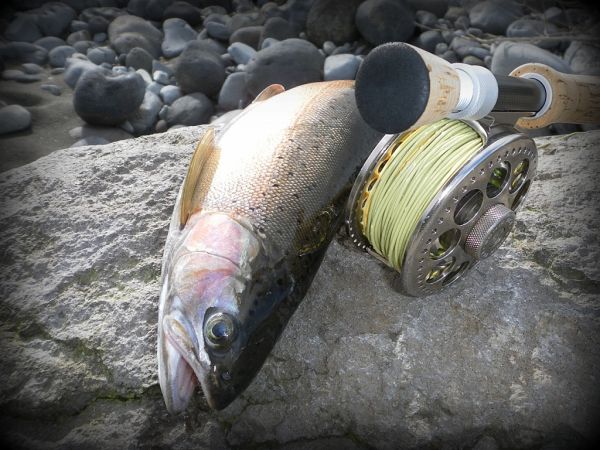
The big news has been the release of Tarawera trout into the Taupo fishery. It has already caused a lot of debate and anglers have voiced opinions both for and against it. Speaking as some one who emigrated from the U.K the Tongariro has always been a very special place to fish. The majority of rainbows in the United Kingdom are still found in stocked lakes and are usually sourced from commercial trout farms.
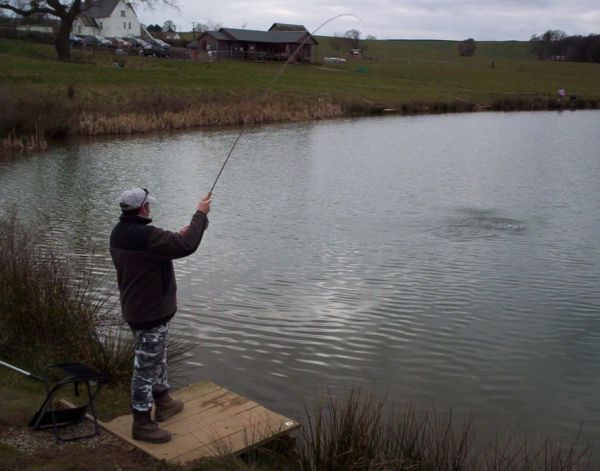 Some of those fisheries also specialize in growing super-size rainbows and the current record stands at almost 37 pounds. Some of those fisheries also specialize in growing super-size rainbows and the current record stands at almost 37 pounds.
When rainbows were originally introduced from North America many of the experts were convinced they would be unable to spawn in U.K waters. But talking to friends over there the fish have proved them wrong and there are now some isolated pockets of rainbows spawning in rivers in the South East of England, Cumbria and Scotland.
I'm told these are resident rainbows not steelheads { migratory } so unlike us lucky lot the opportunities to fish for truly wild rainbows are still very limited.
In fact I don't think they have a wild rainbow trout record.
In any case all U.K rivers are owned by "someone" and unless you belong to a club, syndicate or there are day tickets available fishing a good river would be out of reach for most.
A lot of U.K fly-fisher's practice their sport on day-ticket waters ranging in size from a few acres to large reservoirs that have been opened to the public for recreational use, including angling and then stocked with fish.
Before I was fortunate enough to emigrate every single rainbow trout that I encountered had been bred in a trout farm and were very different animals to our New Zealand steel heads.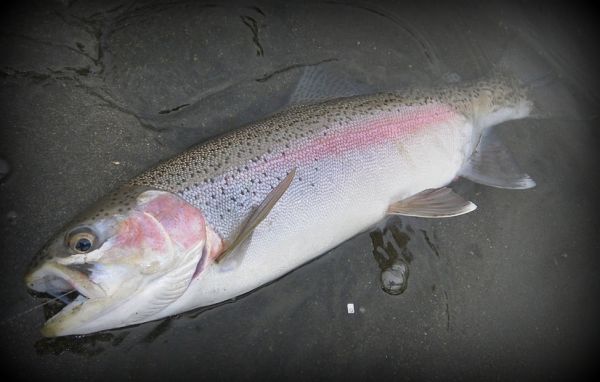
I remember when I began fishing the Tongariro and hooked my first "silver bullet" the experience blew me away. It wasn't only the fantastic surroundings, gin clear river and fighting qualities of the fish I had just landed. What made this so special for me and I suspect for a lot of other visiting anglers, was the knowledge that this trout had lived its entire life with minimal interference from man.
I realise that my concerns will sound a bit hypocritical, after all if it hadn't been for the intervention and efforts of the early European settlers there would be no trout fishing. I also realise that D.O.C have been under pressure to " sort out " the fishery and what ever they did would make someone unhappy but I don't understand why they had to use fingerlings from " outside " the area.
I'm not a scientist or biologist and no doubt all will be explained in the next Target Taupo but if they could have obtained and raised stock from the remaining early spawning Tongariro fish I don't think I would have felt so disappointed.
I know this is not " stocking " as I experienced it back in the U.K ... it just seems like it. After almost 120 years I think the Taupo fishery deserved its self sustaining, "wild" tag and just may be with this particular strategy we've lost a little bit of that magic.
Department of Conservation Media Release
Date: 14 August 2012
Research into Taupo Fishery Early Spawning Runs
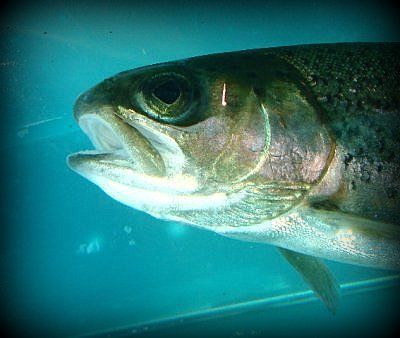
In early August 2012, as part of a small research project, the Department of Conservation released 5000 marked yearling rainbow trout into the Taupo catchment. Fingerlings were released at the river mouths of the Waimarino, Tauranga Taupo and Tongariro Delta. Releases were also made at the Bain, Birch and Blue Pools on the Tongariro River and a small release in Lake Otamangakau.
This experimental release is aimed at researching the feasibility of reinstating and reinforcing the early part of the spawning run that sustains the winter fishery in Taupo. This is part of the project described in the last issue of the fishery magazine “Target Taupo”, and is endorsed by the Taupo Fishery Advisory Committee.
Dr. Michel Dedual, resident fishery scientist says “Tarawera Trout obtained from Eastern Fish and Game were specifically chosen due to the common genetic ancestry they share with Taupo trout, and their early spawning tendencies”. The fish released were of a suitable size to avoid likely predation by browns in the river.
As a follow up to previously published articles, further details about the project will be presented in the upcoming issue of Fish and Game and the next Target-Taupo issue. “Fears that this will undermine the “wild” status of the fishery are unfounded. This is a small experiment involving only 5000 fish, and will have no lasting effects on the wild spawning in the fishery” says Graham Whyman, Chairman TFAC
The trout have been marked with a fluorescent dye identifiable by colour to their release location. The dye has been marked behind their right eye and is clearly identifiable to anglers. These trout will become part of anglers catch in two to three years. If anglers land any of these marked trout, please contact the Taupo-nui-a-Tia area office with the details of location, date, size and colour of dye.
Contacts
Kim Turia, Programme Manager Community Relations,
Department of Conservation Taupō-nui-ā-tia,
Ph (07) 384 7163 kturia@doc.govt.nz
Mark Venman, Programme Manger, Fishery Operations
Department of Conservation Taupō-nui-ā-tia,
Ph (07) 384 7158 mvenman@doc.govt.nz
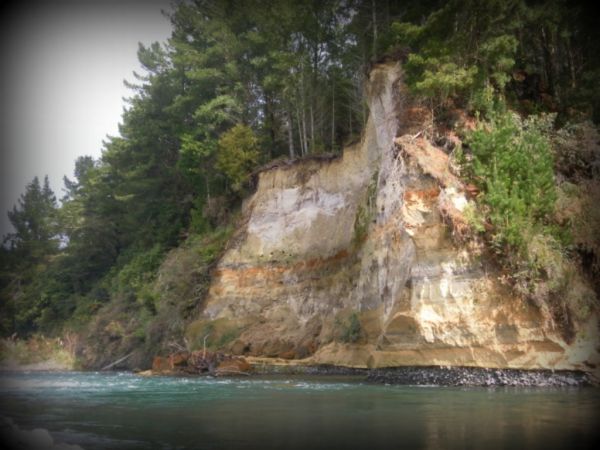 This trip my plan was to concentrate on the middle and upper river with an hour or so around town each day. Chopping and changing my start point every morning meant I fished all these stretches at different times of day. The river is at its slightly higher winter level and looks very fishy. There's also a good even spread of trout and with the earlier spawners dropping back and more runs coming through you get that nice overlap, so you should be able to catch something where ever you fish. This trip my plan was to concentrate on the middle and upper river with an hour or so around town each day. Chopping and changing my start point every morning meant I fished all these stretches at different times of day. The river is at its slightly higher winter level and looks very fishy. There's also a good even spread of trout and with the earlier spawners dropping back and more runs coming through you get that nice overlap, so you should be able to catch something where ever you fish.
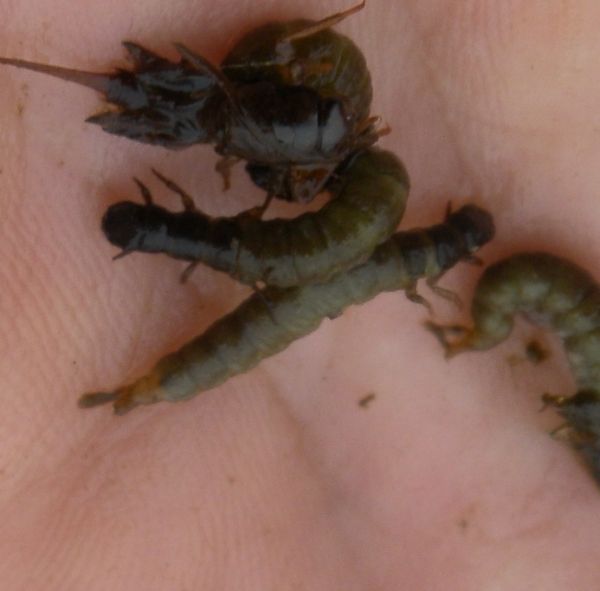 Lots of nymphs and juicy olive green caddis larvae around and the majority of my fish took a larvae imitation used with either method. Fish them through faster riffles for best results. Lots of nymphs and juicy olive green caddis larvae around and the majority of my fish took a larvae imitation used with either method. Fish them through faster riffles for best results.
Poking around like this as I made my way upriver from Red Hut, I had some nice fish and kept a couple of "silver fatties" for the smoker.
As you'd expect there have also been some strong jacks reported, especially round the town pools. This fella which picked up the bomb in Judges gave me a really hard time and even took me for a little jog downstream. It may not be the prettiest fish I've ever caught but it certainly was the best scrap I've had for a while and I hope we meet up again some day.
This and one other fish that took a globug in Cicada were the only ones that went for something other than caddis.
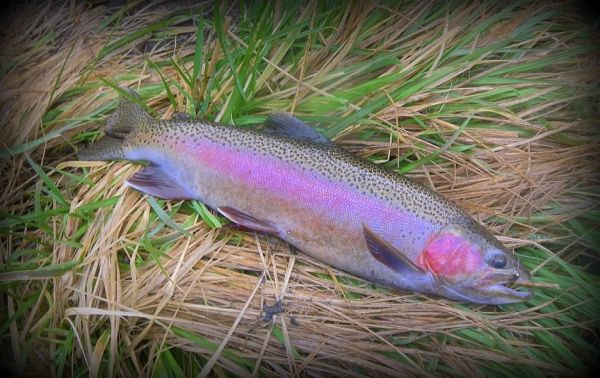 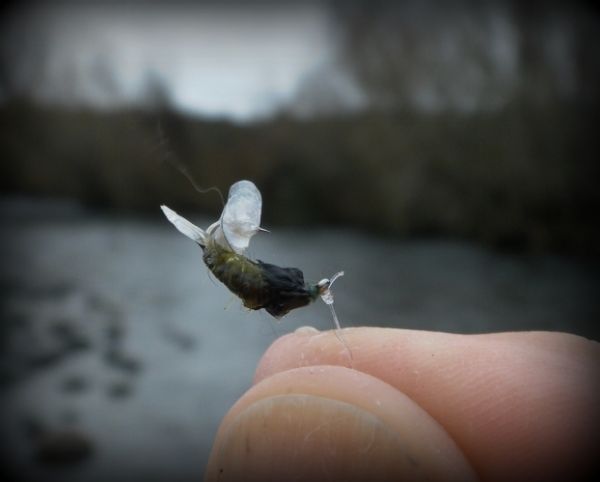
I had another one of those funny weeks where no matter what I did I kept on missing fish. It didn't seem to matter what I was using, after striking I'd feel the fish for a second then nothing except a fly full of scales.
Obviously I'm connecting with the fish outside of the mouth somewhere ... but why? If anybody has worked it out drop me a line.
A nice settled spell of weather for the rest of the week so its looking good. Considering the time of year angling pressure was surprisingly light and on two occasions I didn't see a soul until lunchtime.
Even though its still a bit of a mess from the Braids down I haven't given up on this stretch completely, after all there's still no trout shuttle service between the lower river and the bridge.
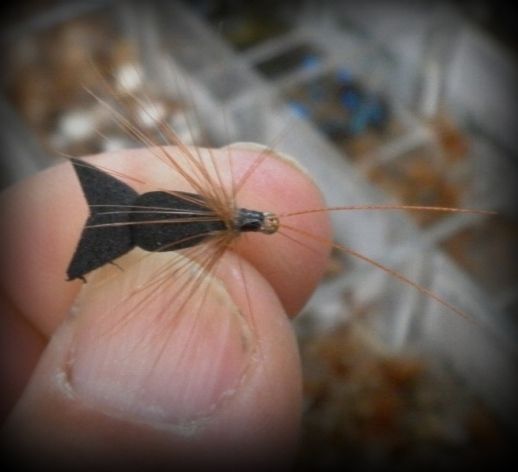
This time its the turn of the team at Sporting Life to suggest a dry for the Tongariro and what else could they say but "the Sporting Caddis."
This little gem is the brain-child of the good looking one behind the counter, no not the boss, the other good-looking one. When I asked for some background on the fly Jared explained that : " Observation is how I came up with it. Looking at caddis during the hatches I went for size and shape. Long hackle for leg movement and feelers for profile. Simple and easy to tie. More along the lines what do fish think? rather than what anglers think. Fish look up, we look down."
Its no surprise that when each of the tackle stores were asked to recommend a dry all of them initially went for a caddis. What's interesting is that first choice for most of them was the " Sporting Caddis " although Graham asked me not to mention that bit because its inventor will be unbearable for weeks.
This guy must have been looking at me when he came up with this weeks fishy quote :
" There he stands, draped in more equipment than a telephone lineman, trying to outwit an organism with a brain no bigger than a breadcrumb, and getting licked in the process." ~ Paul O'Neil, 1965
As most of you know 2012 didn't get off to a particularly good start for me and was my " annus horribilis " which is ancient Welsh for a pain in the arse. Although outwardly there has been a dramatic improvement I still have a little way to go. So I've decided that after I finish the dry fly series, which will be in a couple of weeks, I'm going to take some time out and moth-ball things for a while. The info page will be updated daily but there will be fewer reports until I have more of an idea from the specialists just how much more improvement I can expect.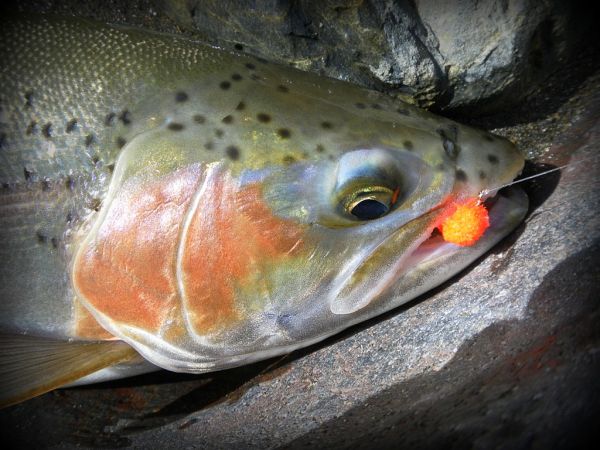
Tight Lines Guys
Mike |
|
|
| Back to Top |
|
|
|
|
| |
| COMMENTS |
|
| That Rainbow looks great to me, I only wish when I am over in early August I can be amongst them. |
|
|
|
| Farbee | Sat 29th March, 2014 | |
|
|
|
| |
|
|
|