| |
|
|
| |
Sunglasses
Mon 15th March, 2010
|
|
|
|
Early March can be a funny ole time on the Tongariro…its that sort of in between period when the fishing becomes a little more challenging. I tend to use those quiet days on the river to go walk about and explore areas I may not have visited for a while. I was downriver checking out the changes again after the January flood when I began thinking about sunglasses.
There were a couple of good browns holed up in a tangle of old tree roots which I probably wouldn’t have spotted without the aid of my Polaroids. It struck me how much we take this important piece of kit for granted. I had always assumed that sunglasses were probably invented a couple of hundred years ago but it turns out their history goes way back further than that.
Ancient Inuit people used a form of eye protection which looked very much like contemporary sunglasses. They carved them from wood or walrus ivory which was flattened, shaped and had a slit cut in each “lens.” These slits not only allowed them to see out but also reduced the amount of reflected sunlight from the snow and ice helping to prevent damage to the eyes.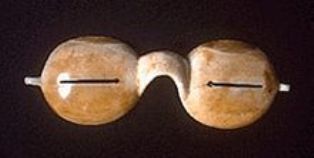
.Records show that the Chinese utilized flat panes of quartz which gave some relief from glare and were often used by Judges in Chinese courts to hide their facial expressions while interrogating witnesses.
Even the Roman emperor Nero is reported to have enjoyed watching gladiatorial fights looking through a couple of emeralds, but whether this gave any actual protection to the eyes is questionable.
In the middle of the 18th century an English optician James Ayscough experimented with green or blue tinted lenses not to shield the eyes from the Sun but because he believed they could help correct certain problems with vision. It was from these first tinted spectacles that many think modern sunglasses evolved
We can thank the movie stars of the early 1900’s for popularizing the wearing of “shades”. Most people believe it was originally to help avoid being recognized by adoring fans. But another equally plausible explanation was their constant exposure to the powerful arc lighting that had to be used because of the slow speed film in use at the time. After a day on set most of the actors were left with reddened eyes and dark glasses were a good way of hiding this.
By the 1920’s sunglasses had become a must have fashion accessory and Sam Foster began mass producing them under the name Foster Grant in New Jersey.
The first polarized lenses appeared around 1936 and were invented by the scientist Edwin Land. In 1937 he co-founded the Polaroid Corporation and although their early success revolved around sheet polarizing filters for sunglasses, during World War II they applied the new technology to military equipment such as target finders, the first smart bombs and a viewing system called Vectograph which helped reveal enemy positions when filmed from the air. In 1947 he demonstrated the first instant camera which eventually became hugely popular world-wide.
Polarizing sunglasses were primarily worn by sportsmen but nowadays more and more people are wearing them for everyday use. Anglers especially appreciate the benefits gained from using them, not only to reduce glare when fishing but to protect the eyes from injury from hooks etc.
When light strikes a reflective surface it becomes polarized which means the photons are vibrating in one direction instead of randomly. This not only distorts the color of objects but causes a mirror-effect which makes it almost impossible to see anything below the surface of the water.
Polarizing sunglasses filter the light waves by absorbing some of this reflected glare while allowing other light waves through. Most of this reflected light is in the horizontal plane so a polarized lens is mounted vertically in the frame and acts a bit like an up ended venetian blind. This prevents most of the horizontal light from reaching the eye but allows the vertically polarized light through enabling the angler to see below the surface.
The right lens color for the conditions can also benefit the fly fisherman when spotting trout: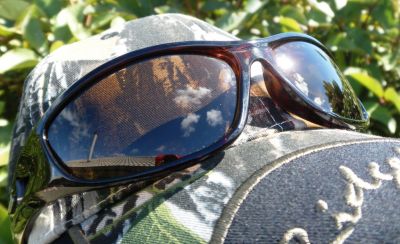
Amber lenses help with contrast and color distinction which make the outline of a fish stand out from its surroundings but they don’t necessarily provide the best protection from full sun glare.
Copper tints are generally accepted as a better choice than amber giving even greater color and contrast enhancement and absorbing more of the blue light rays which cause glare. This makes them an excellent choice for fish spotting in most conditions.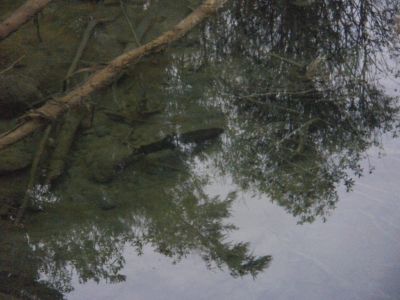
Yellow is useful in shallower water and on overcast days. In low light conditions it utilizes all the available light to help enhance contrast but can also increase color distortion.
Grey is a good general purpose choice providing true color definition, good depth perception and at the same time fights full sun glare.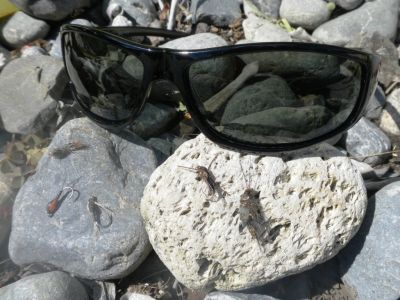
I’m an absolute shocker with sunglasses and have lost count of those I’ve sat on…stepped on…or watched float off downriver. My own preference is to routinely carry two pairs, one with grey lenses the other copper. These two colors will cover most conditions…and when the inevitable happens I still have a back-up pair !
Tight Lines Guys
Mike |
|
|
|
|
|
| Back to Top |
|
|
|
| |
|
|
|